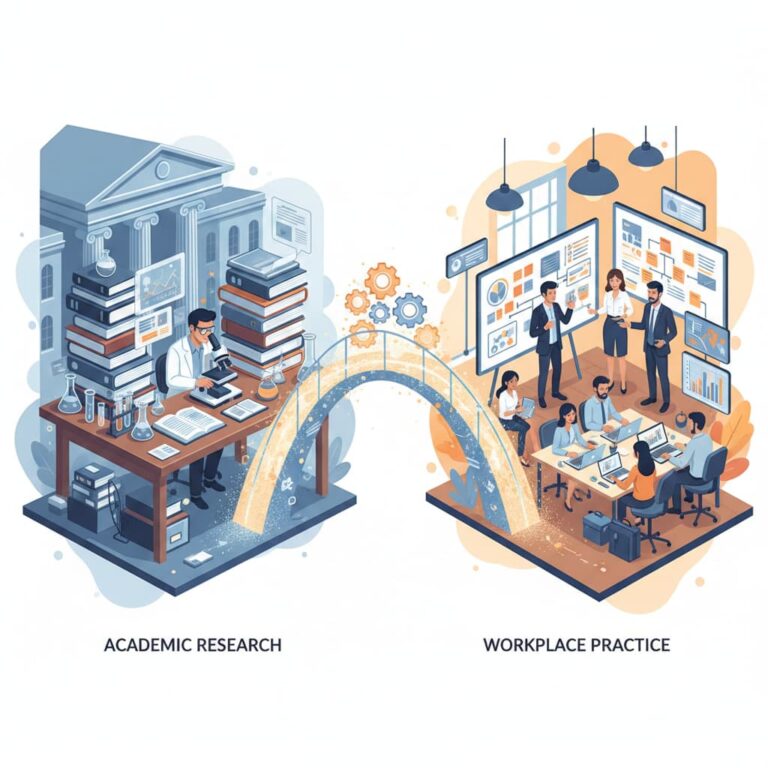
A groundbreaking study on leadership effectiveness is published in a prestigious academic journal. It’s based on five years of rigorous research, thousands of data points, and could revolutionize how organizations develop their managers. Yet three years later, most companies are still using the same outdated training methods from the 1990s.
Welcome to the knowledge-doing gap—the frustrating chasm between what research proves works and what actually happens in workplaces. Every day, thousands of research papers are published across disciplines, from healthcare to education to business management. Yet the average time for research findings to reach practical application? A staggering 17 years in fields like healthcare, and often even longer in other industries.
Why does research so often stay trapped in academic journals, gathering digital dust behind paywalls? The reasons are complex: impenetrable jargon, theoretical frameworks disconnected from messy real-world contexts, and formats designed for peer review rather than practical implementation.
This is where training institutes step in as essential knowledge brokers—translating high-level theory into the practical tools, frameworks, and skills that professionals actually need. They’re the vital bridge in our innovation ecosystem, turning evidence-based research into evidence-based practice.
Why the Gap Exists: The Challenges of Knowledge Translation
The Language Barrier
Academic research speaks a different language. Papers are written for fellow researchers, packed with statistical analyses, theoretical constructs, and discipline-specific terminology. A practitioner looking for actionable insights often needs a PhD just to decode the abstract.
When a study concludes that “interventions demonstrated statistically significant improvements in psychosocial workplace outcomes with a moderate effect size (d=0.52, p<0.01),” what a manager really needs to know is: “This communication technique reduced team conflict by roughly 30% in real companies.”
Time Constraints: The Practitioner’s Dilemma
Professionals are drowning in daily responsibilities. They don’t have 40 hours to read meta-analyses, cross-reference methodologies, or evaluate the quality of competing studies. A nurse can’t spend her afternoon dissecting research protocols when she has patients to care for. A project manager can’t dedicate weeks to reviewing literature when deadlines are looming.
Pro Tip: Research shows that practitioners typically have less than 15 minutes per week to dedicate to professional reading—barely enough time to scan a single journal article, let alone synthesize findings from multiple studies.
The Context Problem: Theory vs. Practice
Research often happens in controlled environments where variables can be isolated and measured. The workplace, by contrast, is gloriously messy. The leadership technique that worked beautifully with motivated volunteers in a university study might fall flat in a understaffed department dealing with budget cuts and organizational change.
These barriers to knowledge translation create a tragic irony: we’ve never had more research available, yet the gap between what we know and what we do continues to widen.
The Training Institute as Translator: The Solution to Bridging the Gap Between Research and Practice
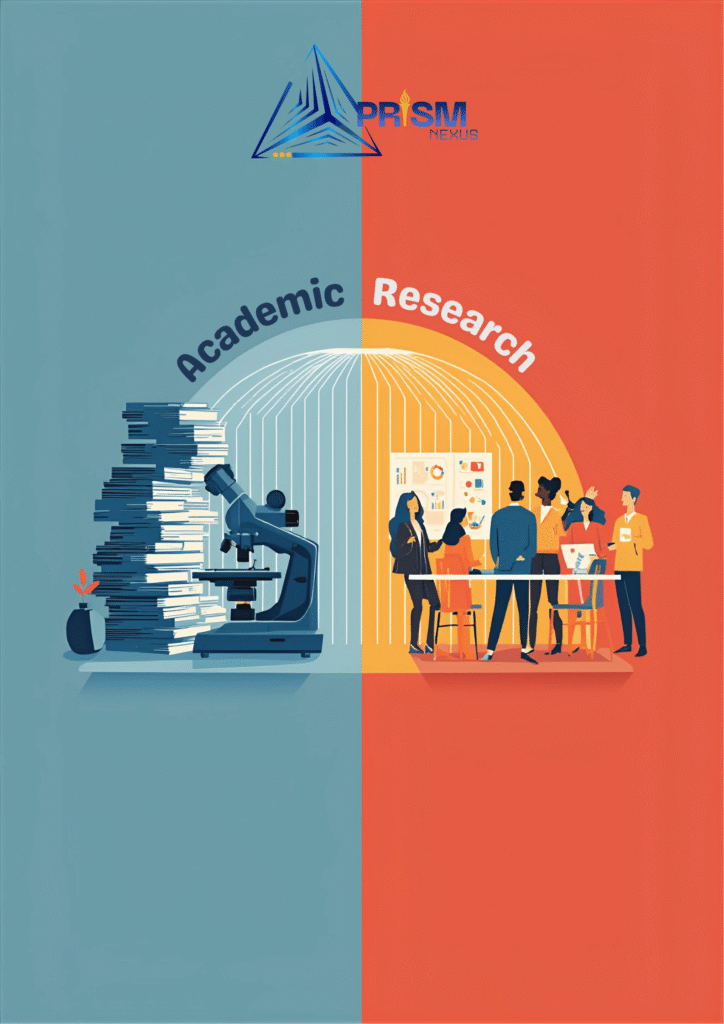
Training institutes occupy a unique position in the professional development ecosystem. Unlike traditional academic institutions focused primarily on research production, and unlike companies focused solely on immediate business results, training institutes exist specifically to facilitate knowledge mobilization.
Curating the Chaos
The sheer volume of published research is overwhelming. PubMed alone indexes over 36 million citations. How does a professional know which studies are rigorous, which findings are replicable, and which interventions actually work outside laboratory conditions?
Quality training institutes employ experts who sift through this data deluge, evaluating methodology, comparing results across studies, and identifying what genuinely works. They’re not just sharing the latest trendy theory—they’re curating evidence-based content that has been vetted for both scientific rigor and practical applicability.
Simplifying Without Dumbing Down
The art of knowledge translation lies in simplifying complex methodologies into step-by-step frameworks without losing the nuance that makes research valuable. A competency-based training program takes the sophisticated findings about skill acquisition and translates them into clear learning objectives, practical exercises, and measurable outcomes.
For example, decades of cognitive science research on how people learn can be distilled into instructional design principles: spaced repetition, active recall, immediate feedback, and contextual application. Training institutes build these evidence-based principles into their curriculum design, even if participants never see the underlying research papers.
Curriculum Agility: Staying Current
Unlike traditional universities, where curriculum changes can take years to implement through committee approvals and accreditation processes, training institutes can update their offerings in real-time as new evidence emerges. When COVID-19 transformed workplace dynamics overnight, agile training institutes quickly incorporated emerging research on remote team management, digital collaboration, and virtual leadership into their programs—often within months rather than years.
Key Takeaway: Training institutes serve as dynamic intermediaries, constantly monitoring both the research landscape and industry needs to ensure their programs reflect the most current, evidence-informed approaches.
Three Ways Institutes Turn Theory into Action
1. Work-Integrated Learning (WIL): From Concept to Application
The most effective training doesn’t just explain theories—it creates opportunities for practical application of research in contexts that mirror real-world scenarios.
Work-integrated learning uses case studies drawn from actual industry challenges, simulations that replicate workplace complexity, and project-based assignments that require applying evidence-based frameworks to participants’ own professional contexts. When a healthcare professional learns about patient communication research through role-playing difficult conversations with simulated patients, the knowledge translation happens experientially, not just intellectually.
This approach directly addresses the context problem. By practicing in scenarios that include the ambiguity, time pressure, and competing priorities of real work environments, learners develop not just theoretical understanding but practical competency.
2. Expert Practitioners: The “Dual Citizens”
The most impactful training institutes employ instructors who are “dual citizens”—equally comfortable in the worlds of research and practice. These professionals might be practitioners who maintain active research agendas, or academics with extensive industry experience.
These expert practitioners understand research methodology well enough to evaluate evidence quality, but they also know what actually works in the field. They can explain not just what the research says, but how to adapt it to different organizational contexts, what implementation challenges to anticipate, and which aspects of a theoretical model are essential versus optional.
This dual perspective is invaluable for evidence-based training. It ensures that content isn’t just academically sound—it’s pragmatically useful.
3. Continuous Feedback Loops: Practice Informs Research
The most sophisticated training institutes don’t just translate research into practice—they create feedback loops where practice informs future research. By gathering data from learners about what works in their actual work environments, which interventions produce results, and where theoretical models break down in real-world application, these institutes contribute to knowledge translation in both directions.
This might involve tracking graduate outcomes, conducting follow-up surveys on implementation challenges, or partnering with researchers to study training effectiveness in field settings. The result is evidence-informed professional development that becomes increasingly refined and context-appropriate over time.
Pro Tip: When evaluating training programs, ask whether the institute conducts any outcome research on its graduates. Programs that study their own effectiveness tend to be more rigorous about evidence-based practices.
The Benefits: Why “Evidence-Based” Training Matters
Investing in What Works
Organizations waste billions annually on training programs based on appealing theories, charismatic trainers, or whatever approach is currently fashionable—regardless of whether these methods actually produce results. The training industry has no shortage of fads: learning styles inventories that lack empirical support, personality assessments with questionable validity, and team-building exercises that feel good but don’t translate to improved performance.
Evidence-based training offers a better return on investment because it focuses resources on approaches proven to work. When a company invests in leadership development that incorporates research-backed principles of adult learning, behavioral change, and skill transfer, they’re far more likely to see measurable improvements in manager effectiveness, employee engagement, and business outcomes.
Research from the Association for Talent Development found that organizations with comprehensive training programs have 218% higher income per employee and 24% higher profit margins than those without. But the key word is “comprehensive”—meaning evidence-based, well-designed programs, not just any training that checks a box.
Future-Proofing: Skills That Endure
Workplace trends come and go, but skills grounded in research tend to have staying power because they’re based on fundamental principles of how people learn, work, and collaborate. An employee who learns evidence-based problem-solving frameworks won’t just be prepared for today’s challenges—they’ll have mental models that adapt to tomorrow’s unknown problems.
This is particularly crucial in rapidly changing industries. While specific technical skills might become obsolete, the metacognitive abilities developed through research-informed training—critical thinking, adaptive learning, evidence evaluation—remain valuable regardless of technological disruption.
Standardization: Industry-Wide Consistency and Safety
In fields where public safety is at stake—healthcare, engineering, aviation—bridging the gap between research and practice isn’t just about efficiency; it’s literally a matter of life and death. When training institutes establish industry standards based on the best available evidence, they help ensure consistent, safe practices across organizations.
The practical application of research through standardized training has dramatically improved outcomes in many fields. Surgical safety checklists, based on research into human factors and error prevention, have reduced surgical complications by up to 47% in hospitals that implement them properly. But research gathering dust in journals wouldn’t have saved a single life—it required knowledge translation through training programs that taught surgical teams how to use these evidence-based protocols.
Knowledge Is Power, But Only When Applied
Training institutes occupy a critical position in our innovation ecosystem. They’re the vital link that transforms research from an academic exercise into practical tools that improve professional practice. Without effective knowledge translation in professional development, even the most brilliant research remains just potential—ideas that could change the world but never do.
- As we’ve explored, these institutes serve multiple essential functions:
- Curating and evaluating research to identify what genuinely works
- Translating complex findings into accessible, practical frameworks
- Designing learning experiences that bridge theory and practice
- Creating feedback loops that inform both better training and better research
The training institute impact extends far beyond individual skill development. When these organizations effectively bridge the research-practice gap, they accelerate innovation across entire industries, elevate professional standards, and ensure that the billions invested in research actually reach the people who can put it to use.
Your Next Step: Choose Evidence-Backed Training
When you’re selecting your next professional development program, look beyond marketing promises and charismatic instructors. Ask critical questions:
- Is this curriculum based on peer-reviewed research or just popular opinion?
- Do the instructors have both academic expertise and practical experience?
- Does the program incorporate work-integrated learning that allows you to practice in realistic contexts?
- Can the institute provide evidence of graduate outcomes and training effectiveness?
Look for certifications and programs explicitly described as “evidence-based,” “research-driven,” or “evidence-informed.” These aren’t just buzzwords—they’re signals that an institute takes seriously its responsibility as a knowledge broker.
The gap between research and practice won’t close itself. It requires intentional, skilled translation—exactly what the best training institutes provide. In choosing evidence-backed professional development, you’re not just investing in your own growth. You’re participating in the essential process of turning knowledge into action, ensuring that the best ideas don’t remain trapped on paper but transform into better practice.
Because knowledge is indeed power—but only when it’s applied.
Want to learn more about choosing the right professional development path? Explore our research-informed professional development programs for evidence-based insights on career growth and skill development.