
Why Understanding Rejection Saves Your Research Career
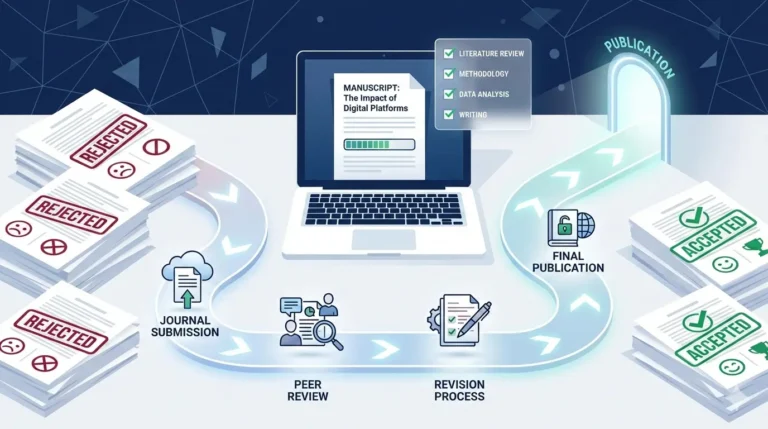
Every researcher dreads that email notification: “We regret to inform you that your manuscript has been rejected.” Unfortunately, this scenario happens more often than most academics realize.
According to recent data, top-tier journals maintain rejection rates between 80-95%. Furthermore, research reveals that 62% of published papers were initially rejected by at least one journal before finding acceptance. These statistics demonstrate that rejection represents a normal part of academic publishing rather than an indication of poor research.
However, understanding why papers get rejected transforms frustration into opportunity. By recognizing common pitfalls before submission, researchers dramatically improve their publication success rates. Moreover, this knowledge helps you select appropriate journals and craft manuscripts that meet rigorous peer review standards.
In this comprehensive guide, we’ll explore the 12 most frequent reasons journals reject research papers. Additionally, you’ll discover practical strategies to avoid each pitfall and increase your chances of publication success.
Understanding the Two-Stage Rejection Process
Before diving into specific rejection reasons, it’s crucial to understand how journals evaluate manuscripts. This knowledge helps you address problems at the appropriate stage.
Stage 1: Editorial Screening (Desk Rejection)
Initially, journal editors conduct a rapid preliminary assessment. This screening happens before your paper reaches peer reviewers. According to Elsevier research, editors reject up to 70% of manuscripts at this stage.
Common desk rejection factors include:
→ Scope misalignment – Research doesn’t fit the journal’s focus
→ Technical completeness – Missing essential elements like figures or references
→ Quality indicators – Poor writing that obscures your contribution
→ Ethical concerns – Suspected plagiarism or duplicate submission
→ Format violations – Failure to follow basic submission guidelines
Importantly, desk rejections typically happen within days or weeks. While disappointing, they allow you to quickly redirect your manuscript to more suitable journals.
Stage 2: Peer Review Rejection
Papers passing editorial screening proceed to expert peer reviewers. These specialists evaluate your research’s technical merit, methodological rigor, and contribution to the field.
Peer review rejections focus on:
→ Methodological flaws – Inappropriate or poorly executed research design
→ Insufficient novelty – Findings that don’t advance knowledge significantly
→ Analytical problems – Statistical errors or unsupported conclusions
→ Literature gaps – Failure to position work within existing research
→ Presentation issues – Unclear communication of important findings
Notably, peer review takes longer—typically 2-6 months depending on the field. However, reviewers often provide detailed feedback that strengthens your manuscript for resubmission elsewhere.
Part 1: Editorial Rejection Reasons (The First Hurdle)
Let’s examine the six most common reasons papers don’t survive initial editorial screening. Understanding these helps you avoid quick rejection and reach peer review.
Reason #1: Your Paper Doesn’t Match the Journal’s Scope
Perhaps the single most preventable rejection reason involves submitting to journals that don’t publish your type of research. Editors quickly identify scope mismatches and reject these papers immediately.
Why this happens:
Researchers sometimes target high-impact journals without checking whether the journal actually publishes work in their specific area. For example, submitting a regional environmental study to a journal focused on global climate models creates an instant mismatch.
Warning signs you’re off-scope:
- The journal hasn’t published similar topics in recent years
- Your methodology differs fundamentally from published papers
- Your research addresses a highly specialized niche the journal doesn’t serve
- Recent issues contain no papers citing literature you reference
How to avoid this pitfall:
First, thoroughly research potential journals before writing your manuscript. Read the journal’s aims and scope statement carefully. Additionally, examine the last 20-30 published articles to understand what topics editors actually accept.
Furthermore, journal selection services can help identify publications genuinely interested in your research area. These services save time and prevent wasted effort on inappropriate submissions.
Reason #2: Poor Manuscript Quality and Presentation
Editors make rapid judgments about manuscript quality based on initial impressions. Consequently, poor writing, formatting errors, or incomplete submissions signal lack of care and preparation.
Common quality issues include:
→ Language problems – Grammar errors throughout that obscure meaning
→ Formatting violations – Ignoring the journal’s style requirements
→ Incomplete submissions – Missing figures, tables, or key sections
→ Poor abstract – Vague or confusing summary of your work
According to Springer Publishing, these technical issues account for a significant portion of desk rejections. While minor spelling errors alone won’t doom your paper, consistently poor presentation suggests the research itself may be flawed.
How to improve presentation quality:
Before submission, invest time in professional editing and proofreading. Have colleagues unfamiliar with your work read the manuscript critically. Moreover, use grammar checking tools and ensure your formatting matches journal requirements exactly.
Remember that presentation quality reflects your professionalism. Therefore, treat submission preparation as seriously as you treated the research itself.
Reason #3: Suspected or Confirmed Plagiarism
Journals take plagiarism extremely seriously because it undermines academic integrity. Modern plagiarism detection software identifies even small instances of unattributed text.
Forms of plagiarism that trigger rejection:
- Copying text from other sources without quotation marks or attribution
- Self-plagiarism (reusing your own previously published work)
- Paraphrasing too closely without proper citation
- Using others’ figures or tables without permission
- Duplicate submission to multiple journals simultaneously
Importantly, even unintentional plagiarism leads to immediate rejection. Furthermore, confirmed plagiarism can damage your reputation and trigger investigations by your institution.
Prevention strategies:
Always use quotation marks when including exact phrases from sources. Paraphrase ideas completely in your own words while still providing citations. Additionally, run your manuscript through plagiarism detection software before submission.
For previously published data or methods, clearly indicate what you’ve published before and cite your own work appropriately. Transparency prevents accusations of self-plagiarism.
Reason #4: The Title and Abstract Fail to Engage
Editors begin their assessment by reading your title and abstract. These elements must quickly communicate your research’s significance and novelty. Vague or poorly written titles and abstracts suggest the full paper has similar problems.
Weak title characteristics:
- Too general (“A Study of Plant Growth”)
- Missing key findings or approach
- Using jargon that limits understanding
- Failing to indicate the research contribution
Abstract problems:
- Lacking clear research questions or objectives
- Omitting methodology details
- Presenting no specific results or findings
- Missing conclusions or implications
Research shows that strong abstracts clearly state the problem, methods, results, and significance within 200-300 words.
Crafting better titles and abstracts:
Create titles that specify your topic, approach, and key finding. For example, “Machine Learning Improves Crop Yield Prediction by 35% in Smallholder Farms” beats “A Study of Crop Prediction.”
Similarly, structure your abstract to answer four questions: What problem did you address? How did you study it? What did you find? Why does it matter? This framework ensures completeness and clarity.
Reason #5: Your Cover Letter Doesn’t Make the Case
Many researchers treat cover letters as formalities requiring minimal effort. However, editors use cover letters to assess whether you understand their journal and can articulate your work’s value.
Cover letter mistakes:
- Generic templates without journal-specific details
- Failing to explain why this journal suits your work
- Not highlighting your paper’s novel contribution
- Omitting suggested reviewers or excluding competitors
- Poor grammar that mirrors manuscript problems
Writing effective cover letters:
Begin by specifically addressing the editor by name. Then explain why your research fits this particular journal’s scope and readership. Furthermore, clearly state your paper’s novel contribution in one or two sentences.
Additionally, suggest 3-5 potential reviewers who have expertise in your area but no conflicts of interest. This helps editors find appropriate reviewers quickly and demonstrates your understanding of the field.
Reason #6: Ethical or Compliance Violations
Journals require authors to meet specific ethical standards regarding human subjects, animal research, data sharing, and conflicts of interest. Missing these requirements triggers immediate rejection.
Common ethical issues:
→ Lack of ethics approval – Human or animal studies without IRB/IACUC approval
→ Missing consent – Failure to obtain participant informed consent
→ Undisclosed conflicts – Not reporting funding sources or competing interests
→ Data availability – Refusing to share data required for verification
→ Authorship problems – Excluding contributors or including honorary authors
Ensuring ethical compliance:
Before beginning research, obtain all necessary ethical approvals. Document informed consent procedures thoroughly. Moreover, disclose all funding sources, potential conflicts of interest, and author contributions transparently.
Many journals now require data sharing statements. Therefore, plan for data deposit in appropriate repositories before submission. This preparation demonstrates commitment to research transparency and reproducibility.
Part 2: Peer Review Rejection Reasons (The Technical Hurdle)
Papers surviving editorial screening face rigorous peer review evaluation. Here are the six most common technical reasons reviewers recommend rejection.
Reason #7: Weak or Unclear Research Question
Strong research begins with a clear, focused question that advances knowledge in meaningful ways. Conversely, vague or poorly defined research questions make it impossible for reviewers to assess your work’s value.
Problems with research questions:
- Too broad to address comprehensively
- Already answered thoroughly in existing literature
- Not scientifically testable or verifiable
- Lacking clear theoretical or practical significance
- Confused or multiple unrelated questions
According to academic publishing research, papers lacking clear research questions account for a substantial portion of peer review rejections.
Developing strong research questions:
First, conduct a thorough literature review to identify genuine knowledge gaps. Then, formulate specific questions that your methodology can definitively address. Additionally, ensure your questions have theoretical implications or practical applications that matter to the field.
Test your research question by explaining it to colleagues outside your subspecialty. If they can’t understand its importance, you need to refine and clarify further.
Reason #8: Methodological Flaws or Inadequate Methods
Reviewers scrutinize your methodology intensely because it determines your findings’ validity. Methodological problems represent one of the most common rejection reasons across all disciplines.
Frequent methodological issues:
→ Inappropriate research design – Method doesn’t match the question
→ Small sample sizes – Insufficient statistical power
→ Missing controls – Lack of comparison groups
→ Outdated techniques – Newer, better methods exist
→ Poor documentation – Insufficient detail to evaluate or replicate
Research from Springer Publishing identifies incomplete data and irreparable methodological deficiencies as primary technical rejection reasons.
Strengthening your methodology:
Plan your methodology carefully during research design, not after data collection. Consult methodological experts and review similar published studies to identify appropriate approaches. Moreover, conduct power analyses to ensure adequate sample sizes before beginning data collection.
In your methods section, provide enough detail that other researchers could replicate your study. Include information about materials, procedures, equipment, analysis software, and statistical approaches. Furthermore, acknowledge methodological limitations honestly while explaining why your approach still produces valid findings.
Reason #9: Insufficient Literature Review and Contextualization
Your literature review must accomplish two critical tasks: demonstrate comprehensive knowledge of existing research and clearly establish how your work adds something new. Inadequate literature reviews suggest you don’t understand your field or your contribution to it.
Literature review problems:
- Citing only old papers (missing recent developments)
- Omitting important contradictory findings
- Failing to synthesize existing knowledge
- Not explaining how your work extends current understanding
- Including irrelevant citations that pad the reference list
Creating comprehensive literature reviews:
Begin by identifying the 20-30 most influential papers in your research area. Then search for recent publications (last 2-3 years) that represent current thinking. Additionally, include papers that disagree with your findings—acknowledging alternative perspectives strengthens credibility.
Organize your literature review thematically rather than chronologically. Synthesize findings to show patterns, gaps, and controversies in existing knowledge. Finally, explicitly state how your research addresses identified gaps or resolves uncertainties.
Reason #10: Lack of Novelty or Original Contribution
Journals seek research that advances knowledge, not studies that merely confirm well-established findings. Therefore, reviewers carefully assess whether your work offers genuinely new insights.
Novelty problems:
- Findings that replicate well-known results without new insights
- Minor variations on existing studies
- Incremental advances that don’t justify publication
- Failure to articulate what’s new or important
- Confirmatory studies without broader implications
Interestingly, research shows that lack of novelty represents the second most common rejection reason after methodological flaws.
Demonstrating originality:
Clearly articulate your unique contribution in the introduction and discussion sections. Explain what was unknown before your study and what is now known because of it. Additionally, highlight methodological innovations, new theoretical frameworks, or unexpected findings that advance understanding.
Remember that novelty doesn’t always mean discovering something completely unprecedented. Sometimes, applying established methods in new contexts, challenging existing assumptions, or synthesizing disparate findings represents valuable novelty.
Reason #11: Poor Data Analysis or Statistical Errors
Even strong data becomes useless when analyzed incorrectly. Reviewers with statistical expertise quickly identify analytical problems that undermine your conclusions.
Common analytical mistakes:
→ Wrong statistical tests – Methods that violate data assumptions
→ P-value misinterpretation – Claiming significance incorrectly
→ Correlation vs. causation – Overstating relationships
→ Missing data handling – Inadequate treatment of incomplete data
→ Multiple comparison errors – Not adjusting for multiple tests
According to Elsevier editors, statistical problems that render findings unreliable constitute a major rejection reason.
Improving analytical rigor:
Consult with statisticians during study design, not just during analysis. Select statistical methods appropriate for your data type and research questions. Moreover, report effect sizes and confidence intervals, not just p-values.
In your results section, present analyses systematically and provide enough detail for reviewers to verify your approach. Additionally, acknowledge analytical limitations and explain how they affect interpretation. Consider sharing analysis code to demonstrate transparency and enable verification.
Reason #12: Conclusions Not Supported by Data
Perhaps the most frustrating rejection reason involves claiming findings that your data don’t actually support. Overstating results or making logical leaps destroys credibility.
Conclusion problems:
- Claiming causation from correlational data
- Generalizing beyond your sample or context
- Ignoring contradictory results in your own data
- Making policy recommendations unsupported by findings
- Speculating excessively without acknowledging uncertainty
Drawing appropriate conclusions:
Carefully align conclusions with your specific findings. Use language that accurately reflects your evidence’s strength—”suggests” rather than “proves” for correlational studies. Furthermore, acknowledge alternative explanations for your results.
In the discussion section, clearly distinguish between what your data show, what they imply, and what remains speculative. Additionally, identify how future research could address limitations and extend your findings. This balanced approach demonstrates scientific maturity and strengthens reviewer confidence.
Beyond the 12 Reasons: Additional Success Factors
While avoiding the 12 common rejection reasons dramatically improves publication chances, several additional factors influence editorial decisions.
Timing and Journal Strategy
Submission timing can affect outcomes surprisingly. For instance, journals near publication deadlines may be more selective, while those with empty pipelines might be more receptive. Additionally, brand-new journals often seek high-quality submissions to establish reputation.
Strategic considerations include:
- Researching journal publication schedules and submission patterns
- Understanding whether journals have special issues aligned with your work
- Considering newer journals with lower rejection rates but growing reputations
- Targeting journals that recently published related work (showing topic interest)
The Importance of Persistence
Remember that 62% of published papers were initially rejected at least once. Therefore, rejection doesn’t mean your research lacks value—it often means you haven’t found the right journal yet.
Persistence strategies:
First, carefully review rejection feedback for valid criticisms. Then strengthen your manuscript based on reviewer comments before resubmitting elsewhere. Moreover, consider broadening your journal targets to include mid-tier publications that might be more receptive.
However, avoid the temptation to repeatedly submit unchanged manuscripts. Instead, use each rejection as an opportunity to improve your work and better understand journal expectations.
The Role of Professional Support
Many researchers benefit from professional editing, statistical consulting, or publication support services. These investments can transform borderline manuscripts into compelling submissions.
When to seek help:
- English isn’t your first language and writing quality concerns you
- Statistical analyses exceed your expertise level
- You’re uncertain which journals might accept your work
- Previous submissions received consistent criticism about specific issues
- You’re preparing a career-defining publication
Organizations like PRISM Nexus offer comprehensive research support including manuscript development, statistical analysis guidance, and publication strategy consultation. Professional assistance doesn’t indicate weakness—it demonstrates commitment to producing high-quality scholarship.
Creating Your Rejection-Proof Manuscript: A Step-by-Step Checklist
Use this comprehensive checklist before submitting your manuscript. Addressing each point significantly reduces rejection risk.
Before You Write
Research Planning:
- Conducted thorough literature review identifying knowledge gaps
- Formulated clear, specific research questions
- Designed methodology appropriate for questions
- Obtained necessary ethical approvals
- Calculated adequate sample sizes
Journal Selection:
- Identified 3-5 potential target journals
- Verified your topic fits each journal’s scope
- Read recent issues to understand acceptance patterns
- Checked submission requirements and formatting guidelines
- Noted average time to publication
During Writing
Structure and Content:
- Crafted specific, informative title
- Written complete abstract covering all key elements
- Organized introduction with clear problem statement
- Documented methods with replication-level detail
- Presented results systematically with appropriate statistics
- Discussed findings without overstating conclusions
- Acknowledged limitations honestly
Quality Assurance:
- Checked all citations for accuracy
- Verified figures and tables are clear and necessary
- Ensured consistent terminology throughout
- Removed jargon or defined technical terms
- Checked for accidental plagiarism
- Proofread multiple times
Before Submission
Final Preparation:
- Formatted manuscript according to journal guidelines
- Prepared all supplementary materials
- Written compelling cover letter
- Identified potential reviewers
- Completed all required submission forms
- Disclosed conflicts of interest and funding
- Confirmed all co-authors approved submission
Professional Review:
- Had colleagues read and critique manuscript
- Addressed their feedback thoroughly
- Considered professional editing if needed
- Verified statistical analyses are correct
- Confirmed ethical compliance documentation
Dealing with Rejection Professionally
Despite your best efforts, rejection still happens. How you respond determines whether rejection derails your research or strengthens it.
The Initial Response: Stay Calm and Objective
Receiving rejection triggers emotional responses—disappointment, frustration, even anger. However, professional researchers recognize that editors and reviewers aren’t attacking them personally.
Productive first steps:
Initially, allow yourself time to process the disappointment. Then, carefully read the decision letter and all reviewer comments multiple times. Moreover, separate emotional reactions from constructive feedback that genuinely improves your work.
Avoid responding to editors immediately while upset. Instead, wait 24-48 hours before deciding your next steps. This cooling-off period enables more rational assessment of the feedback and your options.
Analyzing Rejection Feedback
Decision letters and reviewer comments contain valuable information even when rejecting your paper. Learning to extract useful insights accelerates improvement.
What to look for:
- Consistent criticisms across multiple reviewers (indicating real problems)
- Specific suggestions for strengthening methodology or analysis
- References to papers you should have cited
- Questions revealing unclear writing rather than flawed research
- Comments about journal fit versus research quality
Furthermore, distinguish between fixable problems (inadequate literature review) and fundamental flaws (fatally flawed methodology). This assessment determines whether revision and resubmission makes sense or whether you need to redirect elsewhere.
Your Next Steps After Rejection
Several options exist after rejection. Choosing wisely maximizes your eventual publication success.
Option 1: Revise and Resubmit to the Same Journal
Some rejections invite resubmission after major revisions. In these cases, carefully address every reviewer comment. Then clearly explain your changes in a response letter. This approach works when reviewers identified fixable problems in otherwise strong research.
Option 2: Submit to a Different Journal
More commonly, you’ll redirect to another journal. Before doing so, strengthen your manuscript based on rejection feedback. Additionally, ensure your new target journal genuinely fits your research better than the first choice.
Option 3: Conduct Additional Research
Sometimes reviewers identify genuine limitations requiring more data or analysis. Rather than rushing to resubmit elsewhere, consider whether additional work would significantly strengthen your contribution. Patient investment in quality often yields better eventual placements than hasty resubmissions.
Field-Specific Rejection Patterns
Rejection rates and reasons vary significantly across disciplines. Understanding your field’s specific patterns helps set realistic expectations and tailor your approach.
Sciences and Medicine
Scientific and medical journals often maintain the highest rejection rates. According to recent research, climate science journals show 83% rejection rates, while biomedical journals reject papers reporting null findings 3.5 times more often than those with positive results.
Field-specific considerations:
- Strong emphasis on methodological rigor and statistical power
- Preference for novel findings over confirmatory studies
- High standards for data transparency and reproducibility
- Rapid publication of breakthrough discoveries creating competitive pressure
Social Sciences and Humanities
These fields face different challenges. Theoretical frameworks and interpretive approaches receive more subjective evaluation than experimental data.
Common rejection reasons include:
- Insufficient theoretical grounding or framework integration
- Unclear contribution to ongoing scholarly conversations
- Literature reviews missing key voices or perspectives
- Overreliance on description without sufficient analysis
Applied and Professional Fields
Journals in education, engineering, and professional disciplines often seek research with clear practical applications.
Key success factors:
- Demonstrating real-world relevance and applicability
- Connecting findings to professional practice
- Balancing theoretical rigor with practical utility
- Engaging practitioner audiences alongside academics
The Future of Academic Publishing and Rejection
Academic publishing continues evolving rapidly. Understanding emerging trends helps you adapt your submission strategies.
Open Access and Mega-Journals
Open access mega-journals like PLOS ONE and Scientific Reports publish thousands of papers annually with different criteria than traditional journals. They focus on methodological soundness rather than perceived importance.
Implications for authors:
These venues offer faster publication and lower rejection rates (often 30-50% compared to 80-95% at selective journals). However, they may carry less prestige in some fields. Therefore, strategically consider these options for solid research that might not meet “high impact” criteria.
Preprints and Early Sharing
Increasingly, researchers share work through preprint servers before or during peer review. This practice accelerates knowledge dissemination and can generate useful feedback.
Benefits and considerations:
Preprints establish priority and enable community input before formal review. Nevertheless, some journals don’t accept previously shared work, so check policies first. Additionally, preprints lack peer review validation, requiring careful reader interpretation.
AI and Automated Screening
Some publishers now use AI to assist with initial manuscript screening. These systems identify technical problems, check plagiarism, and even assess writing quality.
What this means for authors:
Automated screening makes technical compliance even more critical. Ensure your manuscript is complete, properly formatted, and free of obvious problems before submission. However, human editors still make final decisions based on scientific merit.
From Rejection to Publication Success
Research paper rejection feels personal and discouraging. However, understanding the 12 common rejection reasons transforms this obstacle into opportunity for growth and improvement.
Remember these key insights:
Most rejections are preventable. Careful attention to journal selection, methodological rigor, clear writing, and proper positioning within existing literature addresses the majority of rejection reasons.
Rejection rates are high for everyone. With top journals rejecting 80-95% of submissions, even excellent researchers face regular rejection. Therefore, don’t interpret rejection as personal failure.
Persistence and revision lead to success. Since 62% of published papers were initially rejected, viewing rejection as a step toward eventual publication rather than an endpoint changes your perspective.
Professional support accelerates success. Whether through colleagues, institutional resources, or services like PRISM Nexus, seeking expert guidance strengthens your work and increases publication chances.
By systematically addressing the 12 common rejection reasons outlined in this guide, you significantly improve your manuscript’s competitiveness. Start by selecting appropriate journals carefully. Then ensure methodological rigor and comprehensive literature coverage. Additionally, write clearly and follow all submission requirements precisely.
Moreover, remember that publication represents just one measure of research value. Sharing findings through conferences, seminars, and collaborations creates impact regardless of journal outcomes. Nevertheless, mastering the publication process enables you to reach broader audiences and contribute more effectively to your field.
Finally, treat each rejection as valuable feedback rather than defeat. Analyze reviewer comments objectively, strengthen weak areas, and persistently pursue publication in appropriate venues. With preparation, patience, and strategic thinking, your research will find its audience.
Ready to Improve Your Publication Success?
At PRISM Nexus, we specialize in helping researchers navigate the complex academic publishing landscape. Our services include:
→ Manuscript development and editing – Strengthening writing and structure
→ Statistical consulting – Ensuring analytical rigor
→ Journal selection strategy – Matching your work with appropriate venues
→ Publication coaching – Guidance through submission and revision processes
Whether you’re facing your first submission or recovering from rejection, our expert team provides personalized support to increase your publication success.
Contact us today to discuss how we can help transform your research into published scholarship.
Frequently Asked Questions About Research Paper Rejection
Q: What percentage of research papers get rejected?
A: Rejection rates vary by journal prestige and field. Top-tier journals typically reject 80-95% of submissions. Mid-tier journals show 50-70% rejection rates, while specialized or newer journals may accept 30-50% of submissions. Overall, approximately 62% of eventually published papers face initial rejection.
Q: How long does it typically take to receive a rejection decision?
A: Desk rejections occur within days to 3-4 weeks. Peer review rejections take longer—typically 2-6 months depending on field and reviewer availability. However, some journals provide decisions within 6-8 weeks while others take 6+ months.
Q: Should I appeal a journal rejection?
A: Appeals rarely succeed unless you can demonstrate clear reviewer misunderstanding or procedural errors. Most rejections are final. Instead, carefully consider feedback, strengthen your manuscript, and submit to a different appropriate journal. Appeals work best for “revise and resubmit” decisions where you disagree with specific reviewer interpretations.
Q: Can I submit my rejected paper to another journal immediately?
A: Yes, you can submit to another journal immediately after rejection. However, first consider whether reviewer feedback identified problems worth addressing. Strengthening your manuscript based on criticism improves chances at the next journal. Additionally, ensure your new target journal doesn’t have policies against previously reviewed manuscripts.
Q: What’s the difference between “reject” and “reject and resubmit”?
A: “Reject” means the journal won’t reconsider your paper even with revisions. You must submit elsewhere. “Reject and resubmit” (or “reject with invitation to resubmit”) suggests the editors see potential but require major improvements. This outcome is more positive and worth pursuing if you can address the concerns raised.
Q: How many journals should I try before giving up?
A: Don’t give up! Many influential papers faced multiple rejections before publication. However, if 3-5 journals reject your work with similar criticisms, seriously consider whether fundamental revisions are needed. Alternatively, your research might suit different journal types or formats than you’re targeting.
Q: Do rejection rates indicate journal quality?
A: Not necessarily. While prestigious journals often have high rejection rates, the reverse isn’t true—high rejection doesn’t guarantee quality. Some journals reject frequently due to poor manuscript quality received, narrow scope, or limited publication space. Therefore, consider multiple factors including impact factor, editorial board, and published content quality.
Related Resources
- How to Choose the Right Journal for Your Research
- Understanding the Peer Review Process: A Complete Guide
- Writing Effective Research Paper Abstracts
- Statistical Analysis Best Practices for Research
- Responding to Reviewer Comments: Templates and Strategies
Share this guide with fellow researchers to help them navigate the publication process and avoid common rejection pitfalls that derail promising research.