Why Great Research Dies on the Shelf Without Dissemination
Imagine spending years conducting groundbreaking research, only to have your findings collect digital dust in an obscure journal that three people read. Unfortunately, this scenario plays out thousands of times annually across academic disciplines.
According to research on dissemination science, the gap between research discovery and real-world application persists primarily due to inadequate dissemination efforts. Furthermore, studies reveal that passive approaches to sharing findings—simply publishing in journals—rarely lead to knowledge uptake or practice changes.
The stakes couldn’t be higher. Research represents massive investments of time, funding, and human effort. When findings remain invisible to those who could benefit most, everyone loses. Patients miss
potentially life-saving treatments, policymakers lack evidence for important decisions, and practitioners continue outdated practices.
However, effective dissemination transforms this equation dramatically. Research shows that well-planned dissemination strategies significantly increase research visibility, credibility, and real-world application. Moreover, many funding organizations now require dissemination plans as standard practice, recognizing that sharing findings matters as much as generating them.
In this comprehensive guide, we’ll explore what research dissemination truly means, why it matters for maximizing impact, and how to develop effective strategies that ensure your work reaches and influences the right audiences.
Understanding Research Dissemination: More Than Just Publishing
Research dissemination involves systematically communicating findings to specific audiences beyond academic circles. Unlike simple publication, dissemination actively targets stakeholders who can use, apply, or benefit from your research insights.
The Core Definition
In academic contexts, dissemination refers to distributing and communicating research findings to broader audiences beyond the scientific community. This process transforms knowledge from specialized academic language into formats accessible and actionable for diverse groups.
Effective dissemination bridges the notorious research-to-practice gap. Rather than waiting for practitioners to stumble upon your published paper, dissemination proactively delivers insights to those who need them most—whether practitioners, policymakers, community organizations, or the public.
Key characteristics of dissemination include:
→ Targeted communication tailored to specific audience needs
→ Active distribution beyond passive publication
→ Multiple formats suited to different contexts
→ Continuous engagement throughout the research process
→ Two-way dialogue enabling feedback and questions
Dissemination vs. Implementation: Understanding the Distinction
While closely related, dissemination and implementation represent different processes. Dissemination focuses on spreading information about research findings—the “what” and “why.” Implementation involves actually using research results to change practices or policies—the “how.”
Think of dissemination as making people aware of evidence-based interventions. Implementation ensures those interventions actually get adopted and sustained in real-world settings. Both processes matter, yet they require different strategies and expertise.
According to NIH definitions, dissemination research examines factors and processes allowing targeted, active distribution of information to key audiences. Implementation research studies how to integrate evidence into practice systematically.
Why Passive Publication Isn’t Enough
Traditional academic publishing represents just one small piece of dissemination. Simply placing your article in a peer-reviewed journal rarely ensures findings reach those who could apply them.
Problems with publication-only approaches:
- Research remains behind paywalls inaccessible to practitioners
- Academic language alienates non-specialist audiences
- Practitioners don’t routinely search scholarly databases
- Findings get buried among thousands of publications
- Time delays between submission and publication slow knowledge transfer
Furthermore, research demonstrates that passive dissemination proves largely ineffective because knowledge uptake doesn’t happen spontaneously. Active, strategic dissemination dramatically improves the likelihood that findings actually influence practice and policy.
Why Research Dissemination Matters: The Case for Impact
Effective dissemination doesn’t just make your research more visible—it fundamentally transforms how your work contributes to knowledge advancement and societal benefit. Let’s explore why dissemination deserves serious attention and resources.
Maximizing Research Value and ROI
Research consumes substantial resources including funding, researcher time, participant contributions, and institutional support. Without proper dissemination, this investment delivers minimal returns.
Consider the economics: Most research receives public or philanthropic funding intended to advance knowledge and improve lives. When findings remain inaccessible, funders cannot justify continued investment. Conversely, widely disseminated research demonstrates clear value and return on investment.
Moreover, federal grants increasingly require dissemination plans as part of application packages. Funding organizations recognize that research impact depends critically on how findings get shared and applied.
Accelerating Knowledge Translation
The gap between discovering something through research and seeing it applied in practice typically spans 17 years in healthcare settings. Dissemination efforts can dramatically shorten this translation timeline.
Benefits of accelerated translation include:
→ Earlier access to effective interventions saving lives or resources
→ Reduced waste from continued use of inferior approaches
→ Faster iteration when research builds on previous findings
→ Cumulative progress as knowledge integrates across studies
According to dissemination science research, communicating findings allows other professionals, stakeholders, and the public to benefit from generated knowledge. This shared learning accelerates collective progress toward solving complex problems.
Influencing Policy and Practice
Perhaps the most significant impact comes when research shapes policies affecting thousands or millions of people. However, policymakers rarely read academic journals or attend scholarly conferences.
Effective dissemination translates research into formats policymakers actually use: brief evidence summaries, policy briefs, one-on-one meetings, and timely responses to emerging issues. These approaches dramatically increase the likelihood that evidence informs crucial decisions.
Furthermore, practitioners implementing programs or interventions need accessible, actionable guidance. Research shows that tailoring communication strategies to different target audiences ensures work gets understood and utilized effectively.
Building Research Credibility and Visibility
Strategic dissemination establishes researchers as thought leaders and go-to experts in their fields. Regular engagement with diverse audiences builds recognition, trust, and influence extending far beyond narrow academic circles.
Additionally, visible research attracts collaboration opportunities, funding, media attention, and invitations to contribute to important initiatives. This visibility creates virtuous cycles where impact generates more opportunities for impact.
Meeting Ethical Obligations to Participants
Research participants contribute their time, experiences, and sometimes significant personal information trusting that findings will benefit others. Failing to disseminate results breaks this implicit ethical contract.
Participants deserve to learn what research revealed and how findings might help others in similar situations. Moreover, studies indicate that participants can become strong advocates for research findings, amplifying dissemination reach when they understand and value results.
Driving Societal and Health Improvements
Ultimately, research aims to improve lives—whether through better treatments, more effective policies, enhanced educational practices, or innovative solutions to pressing challenges. None of these improvements happen without effective dissemination.
According to dissemination research, successful strategies ultimately improve health outcomes, drive policy change, and increase overall research impact. Dissemination represents the critical bridge connecting discovery to real-world benefit.
The Two Types of Dissemination Strategies
Understanding different dissemination approaches helps you select strategies matching your goals, audiences, and resources. Research identifies two main categories of dissemination techniques.
Passive Dissemination Strategies
Passive strategies involve broadly distributing information without tailoring approaches to specific audiences. These methods typically cost less but generate lower engagement and impact.
Common passive strategies include:
- Publishing in peer-reviewed journals
- Posting findings to searchable databases
- Presenting at academic conferences
- Depositing data in open repositories
- Creating research websites
According to dissemination experts, passive strategies prove typically cost-effective but less likely to drive behavioral change or practice adoption. Information becomes available, yet uptake depends entirely on audiences discovering it independently.
When passive strategies work:
Passive dissemination suits situations where audiences actively seek information, such as researchers conducting literature reviews or practitioners searching for evidence on specific topics. Additionally, passive strategies create permanent records of research establishing priority and enabling future discovery.
Active Dissemination Strategies
In contrast, active strategies use specific techniques and communication channels to spread evidence-based information to targeted audiences. These approaches require more resources but generate substantially higher impact.
Effective active strategies include:
→ Tailored communication adapted to specific audience needs and preferences
→ Direct outreach to stakeholders who should know about findings
→ Implementation guides providing step-by-step application instructions
→ Training workshops building capacity to use new approaches
→ Media engagement reaching broader public audiences
→ Policy briefs synthesizing evidence for decision-makers
Research demonstrates that active dissemination dramatically increases knowledge uptake and application. Rather than hoping audiences find your work, you actively place findings in front of those who can use them.
When to invest in active dissemination:
Active strategies make sense when research has clear practice or policy implications, when specific stakeholder groups would benefit from findings, or when funders require evidence of broader impact beyond academic audiences.
Combining Passive and Active Approaches
Most effective dissemination plans combine both passive and active strategies. Passive methods create permanent accessible records while active approaches ensure key audiences actually engage with findings.
For example, you might publish your research in an open-access journal (passive) while also creating policy briefs for legislators (active), presenting at practitioner conferences (active), and engaging with media (active). This multi-pronged approach maximizes both reach and depth of impact.
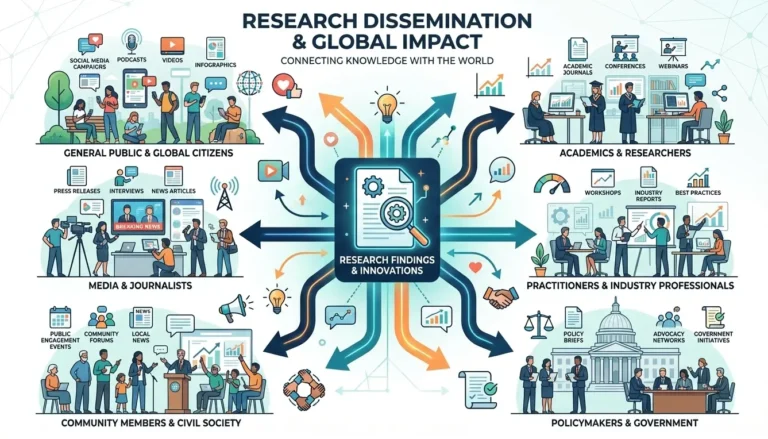
Key Audiences for Research Dissemination
Effective dissemination starts with identifying who needs to know about your findings. Different audiences require tailored approaches reflecting their unique needs, preferences, and constraints.
Academic and Research Communities
Fellow researchers represent traditional primary audiences. They build on your work, test your findings in new contexts, and integrate insights into emerging knowledge.
Reaching academic audiences:
- Publish in high-quality peer-reviewed journals
- Present at discipline-specific conferences
- Share preprints in open repositories
- Engage on academic social networks like ResearchGate
- Collaborate on meta-analyses or reviews
According to dissemination planning guides, academic audiences value methodological rigor, theoretical contributions, and detailed findings. Therefore, scholarly publications and presentations remain essential for this group.
Practitioners and Professionals
Practitioners apply research to their daily work improving services, interventions, or approaches. However, they face different constraints than researchers including limited time, practical resource considerations, and need for actionable guidance.
Effective practitioner dissemination:
→ Professional conferences where practitioners gather
→ Industry publications read by working professionals
→ Webinars and workshops offering continuing education
→ Implementation toolkits providing step-by-step guides
→ Case studies demonstrating real-world application
Furthermore, research indicates that practitioners prioritize practical ways of applying discoveries in their settings. Translate academic findings into clear recommendations practitioners can actually implement.
Policymakers and Government Officials
Policymakers make decisions affecting thousands or millions based on available evidence. However, their information needs differ dramatically from academic audiences.
What policymakers need:
- Brief summaries (1-2 pages maximum)
- Clear policy implications and recommendations
- Local data relevant to their jurisdictions
- Timely information addressing current issues
- Evidence of cost-effectiveness and feasibility
Research shows that policymakers have unique characteristics as dissemination targets including short time horizons and need for jurisdiction-specific data. Policy briefs, one-on-one meetings, and legislative testimony represent effective channels for this audience.
Community Organizations and Advocacy Groups
Community-based organizations working directly with populations your research addresses can become powerful dissemination partners. They understand local contexts, have established trust, and can translate findings into community-specific applications.
Engaging community organizations:
- Present at community forums and town halls
- Create plain-language summaries
- Develop culturally appropriate materials
- Offer training and capacity building
- Establish ongoing partnerships
Moreover, stakeholder engagement research demonstrates that involving community organizations and members throughout research and dissemination processes enhances uptake and impact.
Research Participants
The individuals who contributed to your study deserve to learn about findings. They invested their time, shared experiences, or provided data trusting results would benefit others.
Sharing results with participants:
- Plain-language summaries avoiding jargon
- Community presentations or meetings
- Newsletters or email updates
- Social media posts participants can share
- Thank you communications acknowledging contributions
According to dissemination best practices, participants may assist with sharing results with others and can become strong advocates for study findings.
General Public and Media
For research with broad societal implications, reaching general audiences through media creates awareness and potentially influences public discourse and support for evidence-based policies.
Public engagement strategies:
→ Press releases to news organizations
→ Social media sharing on platforms like Twitter/X, LinkedIn, Facebook
→ Blog posts explaining findings accessibly
→ Podcast appearances discussing research
→ Video abstracts visualizing key points
→ Public lectures and community events
Research from PMC studies emphasizes that social media, podcasts, and other digital platforms enable rapid dissemination to broader audiences while building research visibility.
Developing an Effective Dissemination Plan
Strategic dissemination requires planning, not improvisation. A comprehensive plan ensures your efforts align with goals, reach intended audiences, and use resources efficiently.
Step 1: Define Clear Dissemination Goals
Start by articulating what you want to achieve through dissemination. Vague intentions like “share my research” provide insufficient direction for effective strategy development.
Example dissemination goals:
- Increase practitioner awareness of new intervention by 40% within 12 months
- Influence policy changes in three states within two years
- Build research community around this topic through collaboration
- Ensure 80% of study participants receive results within six months
- Generate media coverage reaching 100,000+ people
According to JBI dissemination guidelines, key objectives should be simple, measurable, and time-bound. These specifications enable later evaluation of whether dissemination succeeded.
Step 2: Identify and Analyze Target Audiences
Comprehensive stakeholder analysis identifies all potential groups with interest in your research including internal audiences (project team, institutional colleagues) and external stakeholders (practitioners, policymakers, public).
For each audience, determine:
- What they need or want to know
- How they currently access information
- Their motivations and barriers
- Preferred communication formats
- Decision-making processes
- Language and literacy considerations
Furthermore, understanding audience motivations and constraints ensures your dissemination efforts connect with the right people at the right time through appropriate channels.
Step 3: Craft Tailored Messages
Rather than using identical language for every audience, adapt messages highlighting aspects most relevant to each group’s interests and needs.
Message adaptation considerations:
→ Level of detail – Policymakers need summaries; researchers want methodology
→ Language complexity – Avoid jargon for general audiences
→ Framing – Emphasize practical benefits for practitioners, cost savings for funders
→ Format – Visual for social media, narrative for stories
→ Evidence type – Statistics for some, case studies for others
Research demonstrates that messaging should put yourself in audiences’ shoes asking what they want or need to know rather than simply what you want to tell them.
Step 4: Select Appropriate Channels and Formats
Different audiences consume information through different channels. Match your dissemination methods to where and how target audiences actually seek information.
Channel considerations:
For researchers: Peer-reviewed journals, academic conferences, preprint servers, ResearchGate
For practitioners: Professional association publications, continuing education webinars, trade magazines, LinkedIn
For policymakers: Policy briefs, legislative testimony, meetings with staff, email updates
For public: Social media, news media, podcasts, YouTube videos, community events
Additionally, research shows that choosing appropriate dissemination channels critically determines whether findings reach intended audiences effectively.
Step 5: Create a Timeline and Budget
Dissemination requires time and resources. Realistic planning prevents last-minute rushed efforts that undermine quality and impact.
Timeline considerations:
- When will research be complete and ready to share?
- What are upcoming opportunities (conferences, policy windows)?
- How long does each dissemination activity require?
- What’s the sequence of activities?
- How will you maintain momentum over time?
Budget elements:
- Open-access publication fees
- Conference registration and travel
- Graphic design for infographics or materials
- Video production for abstracts
- Social media advertising or promotion
- Website development and hosting
- Staff time for dissemination activities
According to dissemination planning resources, strategically planning timelines accounts for external factors and utilizes existing opportunities like themed journal issues or upcoming conferences.
Step 6: Implement Your Dissemination Strategy
With planning complete, execute your strategy systematically while remaining flexible enough to adapt based on what works.
Implementation best practices:
→ Start early – Begin dissemination planning during research design, not after completion
→ Disseminate often – Regular updates maintain interest and demonstrate progress
→ Leverage partners – Collaborate with organizations having established audiences
→ Repurpose content – Adapt core findings into multiple formats efficiently
→ Monitor responses – Track engagement and adjust approaches accordingly
Furthermore, research indicates that disseminating early and often showcases work progress, demonstrates productivity, and enables feedback improving research quality.
Step 7: Evaluate Impact and Iterate
Measuring dissemination effectiveness determines whether efforts achieved intended goals and identifies improvements for future work.
Evaluation approaches:
Quantitative metrics:
- Download counts and page views
- Social media engagement (likes, shares, comments)
- Media mentions and reach
- Conference attendance numbers
- Policy citations of research
Qualitative indicators:
- Stakeholder testimonials about usefulness
- Case studies of research application
- Changes in practice or policy
- Requests for consultation or collaboration
- Quality of engagement in discussions
According to impact assessment research, reach metrics should complement rather than replace qualitative evidence of impact. Both perspectives together provide comprehensive understanding of dissemination effectiveness.
Modern Dissemination Tools and Platforms
Digital technologies have dramatically expanded dissemination possibilities. Understanding available tools helps you select those best matching your audiences and goals.
Academic and Professional Networking Sites
Specialized platforms connect researchers and professionals sharing interests, enabling targeted dissemination to scholarly audiences.
ResearchGate allows uploading publications, sharing data, following researchers, and engaging in discussions. The platform reports views, reads, and citations tracking your research visibility. According to networking research, ResearchGate particularly suits sharing preprints and connecting with academic audiences.
Academia.edu offers strong profile features showcasing achievements, publications, and expertise. Metrics include profile views, document downloads, and geographic distribution of visitors helping assess reach.
LinkedIn connects professionals across industries making it valuable for practitioner dissemination. Share research summaries, engage in discussions, and connect with policy and practice communities.
Social Media Platforms
Social media enables rapid, broad dissemination reaching diverse audiences including those outside traditional academic networks.
Twitter/X facilitates quick sharing of findings, threads explaining research, and engagement with journalists, policymakers, and public. Hashtags increase discoverability and connect conversations across the platform.
Facebook allows longer posts, multimedia sharing, and targeted audience engagement through groups focused on specific topics or communities.
Instagram and TikTok suit visual storytelling making complex research accessible through infographics, short videos, and creative presentations particularly effective for reaching younger audiences.
Research demonstrates that social media has become critical space for knowledge dissemination, community outreach, and creation of communities of practice.
Video and Multimedia Platforms
Visual content often communicates complex findings more effectively than text alone, increasing engagement and understanding.
YouTube hosts video abstracts, research presentations, interviews, and educational content with global reach. Videos remain accessible indefinitely and searchable through Google.
Vimeo offers higher-quality video hosting suited for professional presentations requiring polished production values.
Podcasts enable in-depth discussions of research accessible during commutes or other activities. According to multimedia dissemination research, podcasts describing projects and findings facilitate rapid dissemination when shared across platforms.
Open Access Repositories and Preprint Servers
Making research freely accessible removes barriers preventing broad dissemination.
Institutional repositories like university digital collections archive and disseminate open-access versions of faculty publications, data, and scholarly outputs. These repositories track views and downloads showing how often research gets accessed.
Preprint servers (arXiv, bioRxiv, SSRN) allow sharing findings before formal publication accelerating knowledge dissemination and establishing priority while enabling community feedback.
Open-access journals eliminate paywalls ensuring anyone can read your research regardless of institutional affiliation or ability to pay subscription fees.
Visualization and Infographic Tools
Complex findings often benefit from visual representation making patterns and relationships clearer.
Canva provides templates and tools for creating professional infographics, social media graphics, and presentations without design expertise.
Tableau and Flourish enable interactive data visualizations allowing audiences to explore findings dynamically.
Figshare and Zenodo allow sharing presentations, posters, figures, and datasets with persistent identifiers tracking reuse and citations.
Blogs and Personal Websites
Personal platforms give you complete control over content, messaging, and presentation while building your professional online presence.
Regular blog posts discussing research, explaining findings, or synthesizing evidence establish thought leadership and improve search engine visibility. Furthermore, blogging research shows that offering updates through blogs builds confidence in research and elicits positive feedback.
Measuring Research Impact Beyond Citations
Traditional citation counts represent just one narrow measure of research impact. Modern dissemination demands broader metrics capturing diverse forms of influence and reach.
Understanding Altmetrics
Alternative metrics or “altmetrics” track research attention across digital and social platforms providing immediate, multidimensional impact indicators.
What altmetrics measure:
→ Social media mentions – Tweets, Facebook shares, blog posts
→ News coverage – References in mainstream media articles
→ Policy documents – Citations in government reports or briefs
→ Educational use – Inclusion in syllabi or course materials
→ Public engagement – Downloads, views, comments, discussions
According to altmetrics research, these metrics provide more immediate impact measures and can track non-traditional publications like datasets and code. Moreover, altmetrics offer context and reasons for attention beyond simple citation counts.
Popular altmetrics services:
Altmetric.com aggregates attention from hundreds of sources providing colorful “donut” visualizations showing attention types and sources.
PlumX Metrics tracks usage, captures, mentions, social media, and citations across multiple platforms providing comprehensive attention profiles.
However, limitations exist: Altmetrics measure attention received rather than quality, some disciplines naturally attract more attention, and older publications aren’t well-represented in social media data.
Tracking Policy and Practice Impact
Perhaps the most meaningful impact occurs when research influences real-world decisions and changes.
Policy impact indicators:
- Citations in legislation, regulations, or government reports
- Invitations to provide expert testimony
- Appointment to advisory committees or task forces
- Media coverage influencing public discourse
- Advocacy organization adoption of findings
Practice impact evidence:
- Changes in clinical guidelines or protocols
- Adoption by professional organizations
- Integration into training curricula
- Development of new tools or interventions based on research
- Practitioner testimonials about application
Research from VCU Libraries emphasizes using letters of support from partners and stakeholders as qualitative evidence, along with assessing citation nature rather than just counts.
Assessing Social and Community Impact
Research can improve community well-being, quality of life, and social connectedness. Capturing these impacts requires qualitative and participatory approaches.
Social impact indicators:
→ Community outcomes – Documented improvements in health, education, or welfare
→ Capacity building – Enhanced community knowledge or skills
→ Empowerment – Increased community agency or advocacy
→ Partnerships – Sustained collaborations improving community resources
→ Stories of change – Narratives illustrating research influence
Furthermore, impact assessment guides recommend qualitative evidence discovered by assessing citation nature and conversations about work in news outlets, blogs, and social media.
Using Multiple Metrics Responsibly
No single metric captures full research impact. Responsible assessment combines multiple quantitative and qualitative indicators providing nuanced understanding.
Best practices for metrics:
- Use metrics to inform decisions, not replace judgment
- Understand each metric’s limitations and biases
- Consider discipline-specific norms and expectations
- Value diverse research outputs beyond journal articles
- Emphasize work quality over publication venue prestige
- Recognize different timeframes for various impacts
According to the San Francisco Declaration on Research Assessment (DORA), assessment should emphasize research quality rather than journal impact factors, consider diverse outputs, and recognize that different metrics have different strengths and weaknesses.
Common Dissemination Challenges and Solutions
Even well-planned dissemination efforts face obstacles. Anticipating common challenges allows proactive problem-solving.
Challenge #1: Limited Time and Resources
Researchers already face overwhelming demands. Adding comprehensive dissemination seems impossible given existing commitments.
Solutions:
- Build dissemination into research timelines from the start
- Allocate specific budget for dissemination activities
- Leverage institutional communications or public relations offices
- Partner with stakeholder organizations having established channels
- Prioritize highest-impact activities rather than attempting everything
- Repurpose core content across multiple formats efficiently
According to dissemination planning research, considering skillsets and deciding if additional assistance is needed with dissemination helps overcome resource constraints.
Challenge #2: Academic Incentive Structures
Traditional academic reward systems prioritize peer-reviewed publications and grant funding over dissemination to non-academic audiences.
Solutions:
- Document dissemination activities for tenure and promotion portfolios
- Use altmetrics demonstrating broader impact
- Collect testimonials from practitioners and policymakers
- Track policy or practice changes resulting from research
- Advocate for expanded evaluation criteria valuing public engagement
- Seek institutions and funders prioritizing broader impact
Research indicates that academic culture and incentive structures need shifting to value linking scientists with research users more highly.
Challenge #3: Audience Accessibility Barriers
Target audiences may face barriers accessing dissemination channels including paywalls, technical access, language, or literacy challenges.
Solutions:
→ Publish open access removing paywalls
→ Create plain-language summaries avoiding jargon
→ Translate materials into community languages
→ Use multiple formats (text, audio, video, in-person)
→ Partner with trusted intermediaries having established community access
→ Consider offline channels for audiences with limited internet
Furthermore, stakeholder analysis helps identify and address specific barriers different audiences face regarding receiving information.
Challenge #4: Translating Complex Findings
Research often involves technical complexity challenging to communicate to non-specialist audiences without oversimplifying or misrepresenting.
Solutions:
- Focus on practical implications rather than technical details
- Use analogies and examples making concepts relatable
- Create visual representations of complex relationships
- Test messages with target audience members before broad dissemination
- Consult communication professionals for help translating findings
- Provide multiple detail levels for different audience needs
According to science communication research, messages should be framed to evoke interest, demonstrate usefulness, and connect to audience concerns.
Challenge #5: Measuring Impact Effectively
Demonstrating dissemination impact proves difficult given long timeframes, multiple contributing factors, and challenges isolating your research’s specific influence.
Solutions:
- Establish baseline measures before dissemination begins
- Track both short-term (reach) and long-term (application) indicators
- Use mixed methods combining quantitative and qualitative evidence
- Document case studies illustrating specific influence
- Build evaluation into dissemination planning from start
- Accept that full impact may not be immediately visible
Research from impact evaluation studies recommends allocating resources to measuring long-term outcomes and ensuring long-term content accessibility.
Emerging Trends in Research Dissemination
Dissemination practices continue evolving with technological advances and changing expectations about research accessibility and impact. Understanding trends helps researchers adapt strategies for maximum effectiveness.
Open Science and Open Access Movement
The push toward open science transforms dissemination by making research freely accessible to everyone.
Key open science practices:
- Publishing in open-access journals or repositories
- Sharing research data in public repositories
- Preprinting manuscripts before formal peer review
- Using open-source tools and publishing code
- Engaging public in citizen science projects
According to open science research, transparency and accessibility through collaborative networks increase societal impact and encourage active public involvement.
Multimedia and Creative Dissemination
Beyond traditional text-based formats, researchers increasingly use creative approaches making findings memorable and engaging.
Innovative formats:
→ Video abstracts summarizing research visually
→ Podcasts enabling in-depth discussion
→ Infographics communicating key findings graphically
→ Artistic interpretations through theater, dance, or visual art
→ Interactive visualizations allowing audience exploration
→ Virtual reality experiences illustrating research contexts
Research demonstrates that high-quality videos may have more impact than blog posts, though they cost more to produce.
Real-Time and Continuous Dissemination
Rather than waiting until research completes, researchers increasingly share ongoing progress and preliminary findings.
Continuous dissemination approaches:
- Twitter threads documenting research processes
- Blogging about ongoing studies and challenges
- Sharing preliminary data at conferences
- Engaging stakeholders throughout research phases
- Using preprints for rapid sharing before publication
Furthermore, early dissemination research shows that showcasing progress demonstrates productivity, enables feedback, and builds audience investment in eventual findings.
Stakeholder Co-Creation and Engagement
Traditional one-way dissemination increasingly gives way to collaborative approaches involving stakeholders throughout research.
Co-creation benefits:
- Research questions better match stakeholder needs
- Findings more readily applicable to real-world contexts
- Dissemination built into research from beginning
- Stakeholders become dissemination partners
- Greater trust and uptake of research
According to stakeholder engagement research, involving stakeholders in research and evaluation processes enhances dissemination effectiveness.
Institutional Support and Infrastructure
Universities and research institutions increasingly recognize dissemination importance by providing dedicated support.
Emerging institutional resources:
→ Knowledge mobilization offices coordinating dissemination
→ Communication specialists helping translate findings
→ Media training for researchers
→ Dissemination grants funding public engagement
→ Impact assessment services tracking research influence
Research shows that institutions are creating dissemination grant programs recognizing that finances shouldn’t barrier students or researchers from seeing work to fruition.
Practical Dissemination Checklist
Use this comprehensive checklist ensuring your dissemination strategy covers all essential elements.
Planning Phase
- Defined specific, measurable dissemination goals
- Identified all relevant target audiences
- Conducted stakeholder analysis for each audience
- Analyzed audience needs, preferences, and barriers
- Crafted tailored messages for different audiences
- Selected appropriate dissemination channels
- Created realistic timeline with key milestones
- Developed budget allocating resources to activities
- Identified team members responsible for activities
- Secured necessary approvals or permissions
Content Creation
- Wrote clear, accessible summaries avoiding jargon
- Created visual materials (infographics, slides)
- Developed policy briefs for decision-makers
- Prepared academic publications for peer review
- Recorded video abstracts or presentations
- Designed social media content and campaigns
- Built or updated personal/project website
- Prepared press releases or media materials
- Created implementation guides or toolkits
- Developed participant-friendly summaries
Distribution and Engagement
- Published in appropriate academic journals
- Presented at relevant conferences
- Shared via social media platforms
- Engaged with news media outlets
- Distributed policy briefs to decision-makers
- Conducted practitioner workshops or webinars
- Organized community presentations
- Shared results with research participants
- Posted to institutional repositories
- Collaborated with partner organizations
Evaluation and Follow-Up
- Tracked quantitative metrics (downloads, views, shares)
- Collected qualitative impact evidence (testimonials, case studies)
- Monitored media coverage and policy citations
- Assessed changes in awareness or practice
- Gathered stakeholder feedback on usefulness
- Documented lessons learned for future dissemination
- Identified opportunities for additional dissemination
- Maintained relationships with engaged stakeholders
- Updated dissemination strategy based on results
- Reported dissemination outcomes to funders
Transforming Research Through Strategic Dissemination
Research dissemination represents far more than an afterthought or compliance requirement. Instead, it embodies the bridge connecting discovery to impact, ensuring your painstaking research actually influences the people, policies, and practices it aims to improve.
Throughout this guide, we’ve explored what dissemination truly means—active, strategic communication of findings to diverse audiences beyond academia. Moreover, we’ve examined why dissemination matters so critically: maximizing research value, accelerating knowledge translation, influencing policy and practice, meeting ethical obligations, and ultimately driving societal improvements.
Key principles to remember:
Dissemination requires planning, not improvisation. The most effective approaches identify specific audiences, craft tailored messages, select appropriate channels, and systematically evaluate impact.
Passive publication alone proves insufficient. While peer-reviewed articles remain important, reaching practitioners, policymakers, and communities demands active, multi-channel strategies.
Different audiences need different approaches. What works for researchers (detailed methodology) differs dramatically from what practitioners (implementation guidance) or policymakers (brief evidence summaries) require.
Impact extends beyond citations. Alternative metrics, policy influence, practice changes, and community outcomes all represent meaningful research impact deserving recognition and reward.
Dissemination faces real challenges including limited resources, academic incentive misalignment, and accessibility barriers. However, anticipated obstacles become manageable through planning and partnership.
Modern tools expand possibilities. Social media, multimedia platforms, open-access repositories, and creative formats enable dissemination reaching broader, more diverse audiences than ever before.
The gap between research discovery and real-world application persists unnecessarily. According to dissemination science, this translation gap threatens research impact yet remains addressable through better dissemination.
Every researcher can contribute to closing this gap by treating dissemination as integral to research rather than optional extra. Start planning dissemination during research design, engage stakeholders throughout the process, use multiple channels reaching diverse audiences, and rigorously evaluate what works.
Your research deserves to make a difference. Strategic dissemination ensures it actually does.
Ready to Maximize Your Research Impact?
At PRISM Nexus, we specialize in helping researchers develop and implement effective dissemination strategies that ensure findings reach and influence the right audiences.
Our comprehensive services include:
→ Dissemination planning – Strategic frameworks matching goals, audiences, and resources
→ Message development – Translating complex findings for diverse stakeholders
→ Content creation – Policy briefs, infographics, video abstracts, and multimedia
→ Channel selection – Identifying optimal platforms for maximum reach
→ Impact evaluation – Measuring and documenting research influence
→ Stakeholder engagement – Building partnerships amplifying dissemination
Whether you’re launching a new research project or seeking broader impact for completed work, our expert team provides customized support ensuring your dissemination succeeds.
Contact us today to discuss how we can help transform your research into real-world impact.
Frequently Asked Questions About Research Dissemination
Q: What’s the difference between dissemination and publication?
A: Publication involves sharing findings through peer-reviewed journals or books, representing one channel within broader dissemination. Dissemination encompasses all strategies for communicating research to diverse audiences including practitioners, policymakers, communities, and public—through multiple formats and channels beyond traditional academic publication.
Q: When should I start planning dissemination?
A: Begin dissemination planning during research design, not after completion. Early planning allows stakeholder engagement throughout the process, identification of appropriate channels, budget allocation, and integration of dissemination activities into research timelines. This proactive approach dramatically improves dissemination effectiveness and impact.
Q: How much should I budget for dissemination?
A: Dissemination typically requires 10-20% of total research budgets depending on scope and strategies. Costs include open-access publication fees, conference travel, graphic design, video production, website development, and staff time. Many funders specifically allow dissemination expenses, and some require detailed dissemination budgets in grant applications.
Q: How do I measure dissemination impact?
A: Use mixed methods combining quantitative metrics (downloads, views, shares, citations) with qualitative evidence (stakeholder testimonials, practice changes, policy influence, case studies). Track both immediate reach indicators and longer-term outcome measures. Altmetrics tools like Altmetric.com and PlumX provide comprehensive attention tracking across platforms.
Q: What if my institution doesn’t support dissemination activities?
A: Start small with low-cost strategies like social media, blogging, and presenting at practitioner conferences. Document your dissemination activities and resulting impacts for tenure and promotion. Seek external dissemination grants supporting public engagement. Collaborate with organizations having established communication channels. Advocate for institutional recognition of broader impact measures.
Q: Do I need different strategies for different disciplines?
A: Yes, dissemination approaches vary significantly across disciplines. Sciences often prioritize data visualization and media engagement. Social sciences emphasize policy briefs and practitioner tools. Humanities may use public lectures, exhibitions, or creative formats. Tailor strategies to your field’s norms while innovating to reach non-academic audiences effectively.
Q: How do I balance academic publishing with broader dissemination?
A: Both matter and complement each other. Publish peer-reviewed articles establishing scientific credibility while simultaneously creating accessible versions for other audiences. Use preprints allowing early sharing before formal publication. Repurpose published content into policy briefs, blog posts, and social media. Many funders and institutions now value both traditional publications and broader dissemination equally.
Share this guide with fellow researchers to help them develop effective dissemination strategies that maximize research impact and ensure findings reach those who can benefit most.