Why Most Capacity-Building Programs Fail (And How to Design One That Succeeds)
Your organization just received a capacity-building grant. The board is excited. Staff are hopeful. Consultants are hired. Training sessions begin.
Six months later? Nothing has fundamentally changed.
According to the United Nations, capacity building is “the process of developing and strengthening the skills, instincts, abilities, processes and resources that organizations need to survive, adapt, and thrive in a fast-changing world.” An essential ingredient is transformation generated and sustained from within—going beyond performing tasks to changing mindsets and attitudes.
However, evaluation research consistently reveals that capacity development remains one of the most difficult areas of development practice. Many interventions fail to produce sustainable change because they focus on outputs (training delivered, consultants hired) rather than outcomes (sustained improvements in organizational performance).
The difference between programs that transform organizations and those that waste resources lies in design. This comprehensive guide explores how to create capacity-building programs that generate real, lasting improvements in organizational effectiveness.
Understanding Capacity Building: Beyond Training and Workshops
Capacity building involves more than sending staff to training sessions or hiring consultants for short-term projects. It represents a comprehensive approach to strengthening organizational foundations.
What Capacity Building Actually Means
Kauffman Foundation’s capacity building framework focuses on supporting organizations’ internal effectiveness and long-term stability rather than funding specific programs. These investments strengthen infrastructure, increase resilience, and improve ability to deliver mission over time.
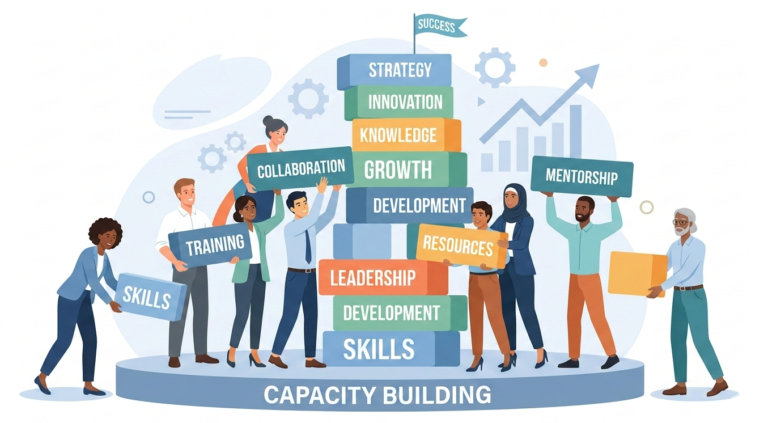
Capacity building addresses multiple organizational dimensions:
→ Leadership and governance – Board effectiveness, executive strength, succession planning
→ Staff and systems – Employee skills, operational processes, technology infrastructure
→ Financial management – Budgeting, sustainability, diversified revenue
→ Strategic planning – Clear vision, measurable goals, adaptive strategies
→ Program quality – Evidence-based approaches, outcome measurement, continuous improvement
→ External relationships – Partnerships, fundraising, community connections
According to capacity building research, these programs represent long-term investments in learning, adaptation, and growth, ensuring organizations can handle challenges and opportunities.
The Three Levels of Capacity Development
Effective capacity building operates across three interconnected levels:
Individual Level:
Developing skills, knowledge, and confidence of staff, leaders, and board members. This includes technical training, leadership development, and professional growth opportunities.
Organizational Level:
Strengthening structures, systems, and processes that enable effective operations. This encompasses strategic planning, financial systems, technology infrastructure, and organizational culture.
Systems Level:
Building networks, relationships, and enabling environments that support organizational effectiveness. This includes sector collaborations, policy advocacy, and community connections.
According to UNDP’s framework, successful capacity development addresses all three levels simultaneously, recognizing that individual capabilities require supportive organizational structures and enabling environments.
Why Traditional Approaches Fall Short
Many capacity-building efforts fail because they employ “extractive” models where consultants provide solutions without building internal capability. Organizations become dependent on external expertise rather than developing sustainable capacities.
Research on capacity building effectiveness identifies common problems:
- Training focuses on knowledge transfer without practical application support
- Consultants deliver reports that sit unused on shelves
- Solutions don’t fit organizational context or culture
- Change isn’t sustained after external support ends
- Measurement focuses on activities (workshops held) not outcomes (performance improved)
Effective programs take developmental approaches that build ownership, adapt to context, and create sustainable internal capabilities rather than temporary fixes.
The Five Essential Elements of Effective Program Design
Successful capacity-building programs share common design elements that distinguish them from ineffective interventions.
Element #1: Thorough Needs Assessment
Before designing any program, conduct comprehensive assessment identifying specific capacity gaps and organizational readiness for change.
Assessment should examine:
→ Current state – What capacities exist now?
→ Desired state – What capacities are needed?
→ Gap analysis – Where are the most critical deficiencies?
→ Root causes – Why do gaps exist?
→ Readiness – Is the organization prepared for change?
According to Kauffman Foundation requirements, effective proposals clearly articulate specific capacity gaps, demonstrate why investment is appropriate as one-time intervention, and show how it positions organizations for long-term impact and sustainability.
Assessment methods include:
- Organizational self-assessments and diagnostic tools
- Staff and board surveys or interviews
- Document reviews (strategic plans, budgets, evaluations)
- Observation of operations and meetings
- Stakeholder consultations
- Benchmarking against similar organizations
Furthermore, capacity measurement frameworks emphasize that clearly articulated definitions of capacity, starting points, and desired endpoints guide effective intervention planning.
Element #2: Clear Theory of Change
Define how specific activities will lead to desired outcomes. A theory of change makes assumptions explicit and creates shared understanding of change pathways.
Theory of change components:
- Long-term goals (organizational transformation desired)
- Intermediate outcomes (capabilities developed)
- Short-term outputs (activities delivered)
- Activities and inputs (specific interventions)
- Assumptions (conditions necessary for success)
- Indicators (measures of progress)
Research from evaluation frameworks demonstrates that programs with explicit theories of change achieve better results because they create alignment, enable adaptation, and facilitate measurement.
For example, a theory of change for financial capacity might specify: “Training (input) → Improved budgeting skills (output) → Better financial decisions (intermediate outcome) → Financial sustainability (long-term goal),” with assumptions about staff retention and leadership support.
Element #3: Contextual Adaptation
No two organizations are identical. Effective programs adapt approaches to fit specific organizational contexts, cultures, and readiness levels.
Context considerations include:
→ Organizational stage – Startup, growth, maturity, decline, transformation
→ Size and structure – Small informal vs. large complex
→ Culture and values – How things get done, what matters
→ Resources available – Time, money, expertise
→ External environment – Sector dynamics, funding climate, community needs
According to capacity development research, different organizational stages require different capacity-building approaches. Exploration-stage organizations need different support than those at implementation or sustainability stages.
Moreover, participatory design approaches that engage organizations in co-creating solutions ensure better fit and stronger ownership than imposed external solutions.
Element #4: Multi-Modal Learning Approaches
Adult learning research demonstrates that varied approaches reinforce learning and enable application better than single-method training.
Effective programs combine:
- Formal instruction (workshops, courses, webinars)
- Coaching and mentoring (individual guidance and support)
- Peer learning (cohort-based exchange, communities of practice)
- Action learning (applying concepts to real challenges)
- Technical assistance (expert support for specific tasks)
- Resources and tools (templates, guides, assessments)
PropelNext evaluation research found that intensive cohort-based programs combining online learning, individualized coaching, peer sessions, and financial support enabled organizations to develop theories of change, strengthen performance management, and engage in continuous improvement cycles.
Additionally, just-in-time support when organizations face specific challenges proves more effective than abstract training delivered too early or too late.
Element #5: Sustainability Planning
From the outset, design for sustainability. How will capabilities continue after external support ends?
Sustainability strategies:
→ Internal ownership – Organization leads, not consultants
→ Skill transfer – Build internal expertise, not dependency
→ Systems integration – Embed new practices in operations
→ Resource allocation – Budget for ongoing maintenance
→ Documentation – Capture knowledge for future reference
Grantmaker research emphasizes that capacity building investments should position organizations for long-term impact rather than creating dependency on continued external support.
The Capacity-Building Program Design Process
Follow this systematic process to design programs that address genuine needs and create sustainable improvements.
Step 1: Define Program Goals and Scope
Start with clarity about what you’re trying to achieve and what’s in or out of scope.
Key decisions:
- What capacity areas will you address? (Can’t fix everything simultaneously)
- What level of change are you targeting? (Individual, organizational, systems)
- What type of outcomes do you seek? (Transitional, transformational)
- What timeframe is realistic? (Avoid overly ambitious timelines)
- What resources are available? (Budget, expertise, time)
According to capacity building frameworks, organizations seeking transitional outcomes (changes in practices, policies, behavior) require different support than those seeking transformational outcomes (shifts in culture, beliefs, structures).
Step 2: Conduct Comprehensive Assessment
Use multiple methods to thoroughly understand organizational capacity gaps and readiness.
Assessment tools:
- Self-assessment instruments and scorecards
- Stakeholder interviews (staff, board, partners, beneficiaries)
- Document analysis (strategic plans, financials, evaluations)
- Observations of operations and governance
- Benchmarking against standards or peers
Research on assessment tools recommends adapting all tools to local context, using mixed methods to cover different measurement requirements, and involving stakeholders throughout assessment processes.
Step 3: Prioritize Capacity Needs
Organizations typically have more needs than resources to address them. Prioritization ensures focus on highest-impact areas.
Prioritization criteria:
→ Impact – Which gaps most limit organizational effectiveness?
→ Urgency – Which needs are most time-sensitive?
→ Feasibility – Which areas are most addressable given resources?
→ Readiness – Where is the organization most prepared to change?
→ Interconnection – Which improvements enable others?
For instance, strengthening financial management may be prerequisite to pursuing growth strategies. Leadership development may be necessary before improving program quality.
Step 4: Design Integrated Interventions
Develop specific activities, delivery methods, and sequencing that address prioritized needs through your theory of change.
Design considerations:
- What learning approaches fit the audience and content?
- What balance of training, coaching, and technical assistance?
- What role will peer learning or cohort models play?
- How will you sequence activities for cumulative impact?
- What support materials, tools, or resources are needed?
- Who will deliver various components?
Effective programs start with thorough needs assessment, define clear objectives, use varied learning methods, provide ongoing support beyond initial training, and measure results continuously.
Step 5: Build in Measurement and Learning
Design measurement systems before implementation begins. Don’t wait until programs end to think about evaluation.
Measurement framework components:
- Baseline data on current capacity levels
- Indicators for progress toward outcomes
- Data collection methods and schedule
- Analysis approaches (qualitative and quantitative)
- Reporting processes for different audiences
- Feedback loops enabling program adaptation
According to measurement research, measurement systems should be integral to design from the start, fostering reflective learning practices and effective use of theory of change.
Step 6: Create Implementation Plan
Develop detailed plans specifying activities, responsibilities, timelines, budgets, and coordination mechanisms.
Implementation planning addresses:
→ Activity scheduling – When will what happen?
→ Responsibility assignment – Who does what?
→ Resource allocation – How will budget be spent?
→ Communication protocols – How will stakeholders stay informed?
→ Quality assurance – How will you ensure quality?
→ Risk mitigation – What could go wrong and how will you respond?
Strong implementation plans enable accountability, coordination, and timely course corrections when challenges emerge.
Step 7: Plan for Sustainability
From the beginning, consider how capabilities will be sustained after formal program support ends.
Sustainability planning includes:
- Identifying which capabilities need ongoing support vs. one-time fixes
- Building internal expertise to maintain new systems
- Integrating new practices into routine operations
- Budgeting for ongoing costs (licenses, maintenance, etc.)
- Documenting approaches for future reference
- Establishing peer support networks beyond program
Measuring Capacity-Building Effectiveness
Effective measurement goes beyond counting training participants or workshops delivered to assess genuine improvements in organizational performance.
The Challenge of Measurement
Capacity building evaluation presents unique challenges:
- Unlike programs with stand-alone outcomes, capacity development supports diverse goals across sectors
- Establishing causal links between activities, organizational performance, and ultimate impact proves difficult
- Long time horizons required for capacity changes to fully manifest
- Abstract concepts like “organizational effectiveness” are hard to operationalize
- External factors beyond programs influence outcomes
Despite these challenges, measurement remains essential for accountability, learning, and continuous improvement.
A Multi-Level Measurement Framework
Measure across multiple levels to capture capacity-building impacts comprehensively.
Level 1: Participant Learning
Did participants gain intended knowledge, skills, or confidence?
Measurement approaches: Pre/post knowledge tests, skill demonstrations, self-efficacy surveys
Level 2: Behavior Change
Are participants applying learning in their work?
Measurement approaches: Observations, self-reports, supervisor assessments, work samples
Level 3: Organizational Performance
Is the organization operating more effectively?
Measurement approaches: Organizational assessment tools, performance metrics, stakeholder surveys
Level 4: Mission Achievement
Is the organization achieving its mission more successfully?
Measurement approaches: Outcome data, beneficiary impacts, goal achievement
According to systematic reviews of capacity building, most current measurement focuses on individual-level outcomes. Organizations should extend measurement to organizational and systems levels for more complete understanding.
Key Performance Indicators
Select indicators aligned with your theory of change and capacity areas addressed.
Example indicators by capacity area:
Leadership and Governance:
- Board meeting attendance and engagement
- Strategic plan development and implementation
- Leadership succession planning in place
Financial Management:
- Diversification of revenue sources
- Operating reserves as percentage of budget
- Financial audit findings
Program Quality:
- Evidence of outcome measurement systems
- Program adaptation based on data
- Beneficiary satisfaction scores
Organizational Systems:
- Staff retention rates
- Technology adoption and utilization
- Written policies and procedures documented
Qualitative and Quantitative Approaches
Effective evaluation combines quantitative metrics with qualitative insights capturing the full story of organizational change.
Quantitative methods:
- Pre/post organizational assessments
- Performance data tracking
- Survey instruments with validated scales
- Administrative data analysis
Qualitative methods:
- Case studies of organizational change
- Stories of significant change
- Key informant interviews
- Participatory evaluation
Moreover, research recommends using mixed methods including outcome mapping, most significant change, case studies, and theory-based evaluation to capture complex capacity development processes.
Timing Considerations
Longitudinal research demonstrates that shifts in practice and culture take time. Programs should plan for:
- Immediate measurement (end of activities)
- Short-term follow-up (3-6 months post-program)
- Medium-term tracking (1-2 years)
- Long-term outcomes (3-5 years when possible)
One groundbreaking study followed organizations for 15 years, revealing marked growth in budgets, people served, data staff, program expansions, and new sites—impacts that wouldn’t have been visible with shorter evaluation horizons.
Common Challenges and Solutions
Even well-designed programs face implementation obstacles. Anticipating common challenges enables proactive problem-solving.
Challenge #1: Resistance to Change
Organizations and individuals often resist capacity-building efforts, especially when change threatens current practices or power dynamics.
Solutions:
- Involve stakeholders in design to build ownership
- Communicate benefits clearly and repeatedly
- Start with willing participants, expand gradually
- Celebrate early wins to build momentum
- Address concerns and fears directly
- Provide support during transitions
Challenge #2: Lack of Leadership Support
Without active leadership engagement, capacity-building initiatives struggle to gain traction or sustain momentum.
Solutions:
→ Engage leaders from program inception
→ Demonstrate how capacity building advances organizational mission
→ Show quick wins and tangible benefits
→ Provide leadership development alongside organizational capacity building
→ Build accountability mechanisms for leadership follow-through
Challenge #3: Insufficient Time and Resources
Organizations often underestimate time and resources required for genuine capacity building.
Solutions:
- Set realistic expectations about timeframes
- Phase implementation to match resource availability
- Leverage external funding when possible
- Build in dedicated staff time for capacity building
- Use peer learning to reduce costs
- Focus on highest-priority areas
Challenge #4: Implementation Drift
Programs sometimes drift from original design, diluting effectiveness or losing focus on intended outcomes.
Solutions:
→ Document design decisions and rationale
→ Maintain clear accountability structures
→ Regular monitoring of implementation fidelity
→ Structured reflection and adaptation processes
→ Strong program management
→ Written implementation protocols
Challenge #5: Measuring Complex Change
Capturing nuanced organizational change proves difficult with simple metrics or short timeframes.
Solutions:
- Use mixed methods combining quantitative and qualitative approaches
- Plan for longitudinal data collection
- Engage stakeholders in participatory evaluation
- Tell stories alongside numbers
- Accept that some outcomes emerge slowly
- Measure process alongside outcomes
Success Stories: Capacity Building That Transforms
Real examples illustrate how well-designed programs create lasting organizational improvements.
PropelNext: Cohort-Based Comprehensive Support
The Edna McConnell Clark Foundation’s PropelNext provided three-year intensive support to youth-serving nonprofits including online learning, individualized coaching, peer sessions, and financial resources.
Organizations developed theories of change, piloted research-informed models, strengthened performance management, and engaged in test-and-learn cycles. Two-year follow-up revealed marked growth in budgets, youth served, evaluation staff, programming, and new sites—demonstrating sustained improvements beyond program participation.
Kauffman Foundation: Targeted One-Time Investments
Kauffman’s capacity building grants support specific capacity gaps with one-time investments ranging from $100,000-$250,000. Organizations have used funding for technology modernization, strategic planning, staff expansion, data systems, and program enhancements.
Examples include organizations updating digital infrastructure, building data systems for tracking outcomes, modernizing CRM systems, conducting formal evaluations, and enhancing cybersecurity—all strengthening internal effectiveness and long-term stability.
PCORI Engagement Awards: Building Research Capacity
PCORI’s capacity building program provides up to $300,000 for two-year projects building capacity of patients, families, caregivers, and healthcare communities to engage in patient-centered research.
Awards support training programs, toolkit development, network building, and infrastructure strengthening that enable meaningful participation in research—transforming how healthcare research incorporates patient perspectives.
The Future of Capacity Building
Emerging trends shape how organizations approach capacity development.
Systems Thinking and Network Approaches
Rather than treating organizations in isolation, newer approaches recognize interdependencies and build collective capacity across networks.
Technology-Enabled Learning
Digital platforms, online communities, micro-learning, and AI-powered tools expand access to capacity-building resources while reducing costs.
Equity and Inclusion Focus
Programs increasingly recognize that capacity building must address power dynamics, center marginalized voices, and build culturally responsive organizational capacities.
Adaptive and Emergent Design
Moving beyond rigid planning, programs embrace iteration, learning, and adaptation based on implementation experience and changing contexts.
Integrated Funding Models
Funders like Kauffman increasingly provide flexible capacity support alongside program grants, recognizing that organizational infrastructure enables programmatic success.
Conclusion: Building Capacity That Lasts
Effective capacity-building programs don’t just deliver training or hire consultants—they create sustainable improvements in organizational performance that enable mission achievement.
The difference between programs that transform organizations and those that waste resources lies in thoughtful design addressing real needs through contextually appropriate approaches with built-in sustainability.
Key principles for success:
Start with thorough assessment understanding specific capacity gaps and readiness for change.
Develop clear theories of change making explicit how activities lead to desired outcomes.
Adapt to organizational context rather than imposing one-size-fits-all solutions.
Use multi-modal learning approaches combining training, coaching, peer learning, and technical assistance.
Plan for sustainability from the beginning, building internal ownership and capability.
Measure what matters across individual, organizational, and mission levels with appropriate timeframes.
Learn and adapt based on implementation experience and emerging evidence.
According to UN definitions, transformation generated and sustained from within represents capacity building’s essential ingredient—going beyond tasks to changing mindsets and attitudes.
Organizations that invest in well-designed capacity-building programs position themselves to survive, adapt, and thrive in fast-changing environments while effectively serving their communities and advancing their missions.
Ready to Design an Effective Capacity-Building Program?
At PRISM Nexus, we specialize in helping organizations design and implement capacity-building programs that create sustainable improvements in organizational effectiveness.
Whether you’re a funder designing grant programs, a nonprofit strengthening internal capacity, or a consultant supporting organizational development, our team provides expert guidance ensuring your capacity-building efforts generate real results.
Contact us today to discuss how we can support your capacity-building goals.
Frequently Asked Questions
Q: What’s the difference between capacity building and training?
A: Training is one component of capacity building, focusing on individual skill development. Capacity building is broader, addressing organizational systems, structures, leadership, and culture alongside individual capabilities. While training transfers knowledge, capacity building creates sustainable organizational improvements.
Q: How long does capacity building take?
A: Timeframes vary by scope and complexity. Specific skill training might take weeks or months. Organizational culture change requires years. Research shows that meaningful organizational transformation often takes 3-5 years. Set realistic expectations and plan for sustained effort rather than quick fixes.
Q: How much should we budget for capacity building?
A: Costs vary widely depending on scope, approaches, and whether you use internal resources or external consultants. Many funders allocate $100,000-$250,000 for targeted interventions. As a general guideline, organizations should invest 5-15% of annual budgets in capacity building for continuous organizational strengthening.
Q: Can we do capacity building without external consultants?
A: Yes, though external expertise often accelerates progress and brings fresh perspectives. Internal approaches include peer learning, staff development programs, and leadership initiatives. The key is dedicating time and resources, whether from internal or external sources.
Q: How do we know if capacity building is working?
A: Effective measurement combines multiple indicators including individual learning, behavior change, organizational performance improvements, and mission achievement. Use baseline assessments, track progress indicators, gather qualitative stories, and conduct follow-up evaluations at appropriate intervals.
Q: What are the most common capacity building needs?
A: Common areas include leadership development, strategic planning, financial management, fundraising, technology infrastructure, program evaluation, board governance, and staff development. Specific needs vary by organizational stage, size, and context.
Q: Should we address multiple capacity areas simultaneously?
A: Focus on highest-priority areas given limited resources. However, recognize that some capacities are interconnected—for example, data systems support both program evaluation and fundraising. Sequential approaches (addressing one area, then another) or integrated approaches (addressing connected areas together) can both work depending on circumstances.
Share this guide to help organizations design capacity-building programs that create lasting improvements in organizational effectiveness and mission achievement.