
The $51.75 Million Lesson in Data Ethics
In 2025, Clearview AI settled a lawsuit for $51.75 million after scraping billions of photos from social media without consent to build facial recognition databases. The violation? Collecting and using biometric data without explicit permission—even though the photos were publicly available.
This case illustrates a crucial truth: ethical data collection isn’t just about following laws. It’s about respecting human dignity, protecting vulnerable populations, and building trust that enables research to exist at all.
According to data ethics research, ethics is more of a process and culture that needs adoption by everyone involved in development and implementation. It’s not a checklist to complete—it’s a fundamental approach to how we treat people whose information we use.
Imagine participating in a survey, only to later realize your responses were used in ways you never agreed to. As researchers note, in the rush to collect data, ethical considerations are often overlooked—but they shouldn’t be.
In this comprehensive guide, we’ll explore core ethical principles, practical implementation strategies, legal requirements, and common challenges in ethical data collection for research.
Core Principles of Ethical Data Collection
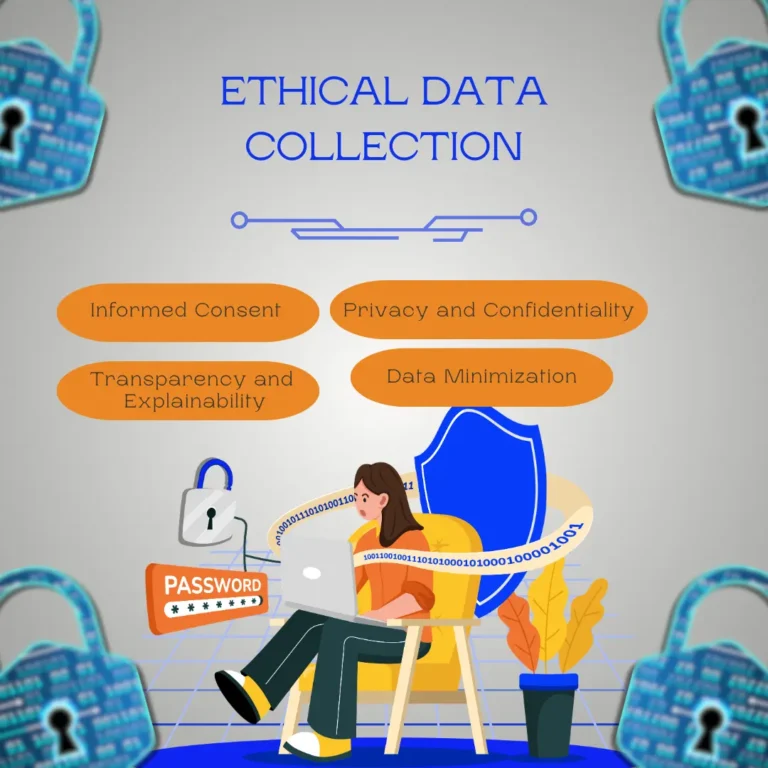
Six fundamental principles guide ethical data practices across all research contexts. These principles provide the foundation for policies, procedures, and day-to-day decisions.
Principle #1: Informed Consent
Informed consent represents the cornerstone of ethical data collection. Research emphasizes that consent forms should be simplified and not overwhelming, ensuring respondents fully understand what’s expected and give truly informed consent.
True informed consent requires:
→ Clear explanation of what data will be collected
→ Explicit purpose statement for how data will be used
→ Voluntary participation without coercion or undue influence
→ Right to withdraw at any time without penalty
→ Comprehensible language appropriate for participant literacy levels
→ Adequate time to review and ask questions
According to GDPR principles, consent must be given for an explicit and stated purpose. Organizations shouldn’t collect data now for undefined future uses.
Principle #2: Privacy and Confidentiality
Privacy protection means safeguarding personal and sensitive information from unauthorized access. Researchers must implement measures such as anonymization and encryption to protect participants’ privacy.
Privacy protection strategies:
- Remove personally identifiable information (PII) when possible
- Use pseudonyms or codes instead of names
- Store consent forms separately from research data
- Limit access to identified data to essential personnel
- Secure storage with encryption and access controls
- Plan for data destruction after retention period
Furthermore, data privacy means people should have reasonable expectation that their data will be protected from public exposure. This expectation extends beyond legal minimum requirements to ethical obligations.
Principle #3: Transparency and Explainability
Transparency requires that data providers be aware of what data is being collected, who will have access, and how it will be utilized. Additionally, providers should have control over how their data is used.
Transparency practices include:
→ Clear communication about data collection methods
→ Open policies about data sharing and usage
→ Accessible information about participant rights
→ Honest disclosure of potential risks
→ Regular updates if data use purposes change
Organizations demonstrate transparency through clear privacy policies, plain language explanations, and opportunities for participants to ask questions and receive honest answers.
Principle #4: Data Minimization
According to privacy experts, purpose limitation supports collecting only minimum data necessary for intended results. GDPR principles require collecting and retaining only minimum data necessary for the intended purpose.
Data minimization means:
- Collecting only information directly relevant to research questions
- Avoiding “nice to know” data that might be useful someday
- Asking each survey question: “What unique information does this provide?”
- Determining if collected information directly contributes to answering research questions
- Removing questions that duplicate information or lack direct relevance
Research guidance emphasizes collecting minimum information needed to answer questions. Burdening respondents with longer surveys and unnecessary data sharing is unethical.
Principle #5: Accountability and Responsibility
Clear responsibility must exist for data practices and decisions. Accountability includes defined data ownership, documented processes, and mechanisms for redress when harm occurs.
Accountability mechanisms:
→ Data governance councils providing oversight
→ Ethics review boards evaluating research protocols
→ Documented procedures for data handling
→ Audit trails tracking data access and use
→ Incident response plans addressing breaches
→ Clear ownership of data throughout lifecycle
Organizations establish accountability through metadata tracking, approval workflows, and systems documenting who accessed data, what transformations occurred, and which rules applied at each stage.
Principle #6: Fairness and Equity
Fairness principles require avoiding discrimination or bias in data practices. Benefits and risks should be distributed fairly among different groups and communities.
Fairness considerations:
- Ensuring diverse representation in research samples
- Avoiding systematic exclusion of vulnerable populations
- Examining data collection methods for embedded biases
- Testing algorithms and analyses for discriminatory outcomes
- Distributing research benefits equitably across communities
- Addressing historical research abuses affecting specific groups
Researchers must consider how power dynamics, cultural contexts, and historical injustices shape ethical data collection in specific communities.
Legal Frameworks Governing Data Collection
Understanding legal requirements provides baseline standards for ethical data collection, though ethical obligations often extend beyond legal minimums.
GDPR: European Union Data Protection
The General Data Protection Regulation applies to organizations processing data of people within the European Union, regardless of organization location.
Key GDPR requirements:
→ Lawful basis for processing personal data
→ Data subject rights (access, rectification, erasure, portability)
→ Consent requirements for specific, informed, freely given agreement
→ Data protection by design integrating privacy from project start
→ Breach notification within 72 hours of discovery
→ Data Protection Impact Assessments for high-risk processing
GDPR establishes substantial fines for violations, creating strong incentives for compliance alongside ethical motivations.
HIPAA: US Healthcare Data Protection
The Health Insurance Portability and Accountability Act governs healthcare data in the United States, establishing strict protections for protected health information (PHI).
HIPAA principles:
- Minimum necessary standard for data access and disclosure
- Individual rights to access and amend health records
- Safeguards for physical, technical, and administrative security
- Business associate agreements for third-party data processors
- Privacy notices explaining information practices
Institutional Review Boards (IRBs)
Most research institutions require IRB approval before beginning research involving human subjects. IRBs evaluate:
- Potential risks to participants
- Adequacy of informed consent procedures
- Privacy and confidentiality protections
- Special protections for vulnerable populations
- Scientific merit justifying participant burden
IRB review represents critical ethical oversight ensuring independent evaluation of research ethics.
Best Practices for Ethical Data Collection
Translating principles into practice requires specific strategies addressing common data collection scenarios.
Creating Effective Informed Consent
Informed consent design should ensure respondents fully understand expectations and give truly informed consent through simplified, non-overwhelming forms.
Consent form essentials:
→ Study purpose and procedures in plain language
→ Time commitment required from participants
→ Potential risks and benefits honestly disclosed
→ Confidentiality measures protecting privacy
→ Voluntary nature and withdrawal rights
→ Contact information for questions
→ Signature and date documenting agreement
Test consent forms with people similar to your target population. If they don’t understand key elements, revise until clarity is achieved.
Implementing Robust Security Measures
Security implementation requires robust measures like encryption, access controls, and secure storage safeguarding sensitive data from unauthorized access or breaches.
Security best practices:
- Encrypt data during transmission and storage
- Use secure, password-protected systems
- Implement role-based access controls
- Maintain separate consent forms from research data
- Regular security audits and updates
- Incident response plans for breaches
- Staff training on security protocols
According to Gartner projections, global spending on security and risk management will reach $212 billion in 2025, reflecting growing recognition of data protection importance.
Protecting Anonymity Through De-identification
De-identification techniques apply anonymization to remove or obfuscate personally identifiable information from datasets protecting participants’ privacy.
De-identification methods:
→ Direct identifiers removal (names, addresses, phone numbers)
→ Generalization of specific details (exact age → age range)
→ Suppression of rare characteristics enabling re-identification
→ Pseudonymization using codes instead of identifiers
→ Aggregation presenting only group-level statistics
However, researchers warn that merging separate datasets with just a few personal pieces can enable re-identification. Consider how different data points might be combined to reverse engineer identity.
Managing Sensitive Data
Sensitive data handling requires careful consideration. Such questions should only be asked when absolutely necessary and worded to minimize participant harm risk.
Sensitive data considerations:
- Justify necessity thoroughly
- Use indirect or proxy measures when possible
- Provide clear rationale to participants
- Offer response options like “prefer not to answer”
- Implement extra security protections
- Consider cultural contexts shaping sensitivity
- Provide support resources if topics may distress participants
What constitutes “sensitive” varies across cultures and contexts. Researchers must understand community norms and values.
Addressing Power Dynamics
Power considerations recognize how dynamics might make respondents feel pressured, influencing data quality. Consider your positionality and how it shapes participant responses.
Power-aware practices:
→ Independent data collectors not connected to services participants receive
→ Clear separation between research and service provision
→ Assurances that participation won’t affect service access
→ Cultural humility acknowledging researcher limitations
→ Community involvement in research design and interpretation
For example, collecting data on behalf of service-providing organizations may cause respondents to hesitate giving negative feedback, fearing it could affect future access.
Common Ethical Challenges and Solutions
Even well-intentioned researchers face ethical dilemmas. Recognizing common challenges enables proactive problem-solving.
Balancing Data Needs With Privacy
Researchers often want comprehensive data while participants desire maximum privacy protection. Finding appropriate balance requires thoughtful consideration.
Solutions:
- Prioritize essential data over “nice to have” information
- Use aggregated or anonymized data when possible
- Implement tiered consent allowing participants to choose sharing levels
- Employ privacy-enhancing technologies like differential privacy
- Regularly reassess whether initially planned data collection remains necessary
The Cambridge Analytica scandal, where over 50 million Facebook users’ data was collected for political advertising without informed consent, demonstrates the severe consequences of prioritizing data accumulation over privacy.
Obtaining True Voluntary Consent
Participation that’s technically voluntary may involve subtle coercion through power imbalances, financial inducements, or social pressure.
Solutions:
→ Avoid excessive incentives that might unduly influence participation
→ Provide alternatives for fulfilling requirements (e.g., alternative assignments for students)
→ Use neutral recruitment language avoiding pressure
→ Emphasize voluntary nature repeatedly
→ Allow withdrawal without explanation or penalty
Survey researchers should carefully consider incentives like monetary rewards or gift cards. While incentives increase participation, they can also constitute coercion.
Preventing Harm to Participants
The Tuskegee Experiment—where researchers failed to treat Black men suffering from syphilis and directly misled them about their health, causing over 100 deaths—demonstrates the severe consequences of unethical research.
Solutions:
- Conduct thorough risk assessments before beginning research
- Implement safeguards proportionate to risk levels
- Provide referrals to support services when research addresses sensitive topics
- Monitor participants for adverse reactions
- Establish clear stopping rules if harm is detected
- Maintain liability insurance for research activities
Medical research today has strict ethical guidelines preventing participant harm, developed in response to historical abuses.
Maintaining Confidentiality
Organizational research provides good examples of reputational harm. Employees speaking negatively about bosses may face repercussions if their data was shared publicly with identifiable information.
Solutions:
→ Aggregate data in reports rather than showing individual responses
→ Use sufficient sample sizes preventing identification from demographics
→ Obtain proper consent for any identified data sharing
→ Separate identifying information from research responses
→ Secure storage with limited access
Data collection practices putting participants in jeopardy should be carefully scrutinized.
Navigating Legal Complexity
Different jurisdictions have varying data protection laws. Multi-national research must comply with multiple frameworks simultaneously.
Solutions:
- Consult legal experts familiar with relevant jurisdictions
- Adopt highest applicable standard across all locations
- Document compliance efforts thoroughly
- Obtain legal review of data collection protocols
- Stay informed about evolving regulations
- Build compliance costs into research budgets
Privacy laws in many countries and jurisdictions should be carefully considered and incorporated in data collection projects, mitigating possibility of legal violations while respecting survey subjects’ interests.
Implementing an Ethics Framework
Systematic approaches translate principles into operational reality through policy, technology, and culture.
Step 1: Develop Clear Policies
Establish written policies governing all data collection activities.
Policy elements:
- Ethical principles guiding decisions
- Roles and responsibilities
- Required approvals and oversight
- Data handling procedures
- Training requirements
- Violation reporting and response
- Regular review and updates
Organizations should develop clear, implementable policies ensuring transparency and creating oversight mechanisms addressing conflicts impartially.
Step 2: Provide Comprehensive Training
Providing sufficient training about data collection ethics benefits promoting and adopting culture. Training should cover:
→ Ethical principles and their application
→ Legal requirements in relevant jurisdictions
→ Specific procedures for consent, security, confidentiality
→ Recognizing ethical dilemmas and when to seek guidance
→ Case studies illustrating common challenges
→ Organization-specific policies and expectations
Staff handling sensitive data require ongoing education on ethical and secure handling importance, including protocols for responding to breaches or incidents.
Step 3: Use Ethics Checklists
A best practice ensuring instructions are followed is using ethics checklists that staff tick off whenever collecting data.
Checklist items might include:
- IRB approval obtained and current
- Informed consent process documented
- Privacy protections implemented
- Security measures activated
- Data minimization verified
- Participant rights information provided
- Emergency contact information available
However, frameworks aren’t infallible and require ongoing monitoring. They’re not complete substitutes for close engagement with substantive ethical issues.
Step 4: Establish Oversight Mechanisms
Create structures ensuring ongoing ethical accountability.
Oversight approaches:
→ Ethics committees reviewing protocols
→ Data governance councils setting standards
→ Regular audits assessing compliance
→ Incident reporting systems surfacing problems
→ Stakeholder feedback from participants and communities
Step 5: Build Ethical Culture
Technical compliance alone doesn’t create ethical research. Organizations must foster cultures valuing ethics as fundamental to research mission.
Culture-building strategies:
- Leadership modeling ethical behavior
- Recognizing and rewarding ethical practices
- Creating safe reporting for ethical concerns
- Discussing ethical dilemmas openly
- Integrating ethics into performance evaluations
- Celebrating ethical improvements
According to implementation research, ethics is a process and culture requiring adoption by all contributors in development and implementation.
Real-World Case Studies
Learning from both failures and successes illustrates ethical principles in action.
Case Study #1: Health Insurer AI Claims (Failure)
In early 2025, major health insurers faced lawsuits for using AI algorithms allegedly denying medical claims unfairly. One filing cited Cigna’s internal process where an algorithm reviewed and rejected over 300,000 claims in two months.
Ethical failures:
- Inadequate human review of automated decisions
- Lack of transparency about algorithmic decision-making
- Insufficient accountability mechanisms
- High-stakes health decisions made without adequate oversight
Lessons learned:
When AI makes consequential decisions affecting health access, organizations must ensure adequate oversight, explainability, and appeal mechanisms. Regulators increasingly scrutinize automated decision-making in sensitive domains requiring human judgment.
Case Study #2: Amazon Alexa Data Collection (Failure)
Amazon received negative headlines following a 2021 lawsuit accusing Alexa smart speakers of secretly collecting and storing user data. Research suggested Alexa collects sensitive voice and biometric data, sharing insights with as many as 41 advertising partners.
Ethical failures:
→ Insufficient transparency about data collection extent
→ Unclear communication about data sharing with third parties
→ Lack of meaningful user control over collected data
Lessons learned:
Transparency about what data is collected and with whom it’s shared is essential. Users deserve clear information enabling informed decisions about device use.
Case Study #3: Apple On-Device Processing (Success)
Apple’s on-device processing demonstrates data ethics through design. By processing information locally on devices rather than sending to servers, Apple minimizes data collection while maintaining functionality.
Ethical strengths:
- Data minimization by design
- Enhanced privacy through technical architecture
- User control over data sharing
- Transparency about processing locations
Lessons learned:
Privacy-enhancing technologies can enable functionality while respecting user privacy. Ethical data practices can become competitive advantages.
Ethics as Foundation, Not Afterthought
Ethical data collection isn’t a burden hindering research—it’s a foundation enabling research to exist. When participants trust that researchers will protect their information, respect their autonomy, and use data responsibly, they willingly share insights advancing knowledge.
In the rush to collect data, ethical considerations are often treated as afterthoughts. However, they should be priorities starting in planning phases, especially in development and humanitarian spaces.
Core principles to remember:
Informed consent is cornerstone, not checkbox. Ensure participants truly understand and voluntarily agree.
Privacy and confidentiality protect participants from harm. Implement robust safeguards proportionate to data sensitivity.
Transparency builds trust. Be clear about what you’re collecting, why, and how it will be used.
Data minimization reduces risk. Collect only what’s necessary to answer your questions.
Accountability creates responsibility. Establish clear oversight and consequences for violations.
Fairness ensures equity. Distribute benefits and burdens justly across communities.
When businesses follow ethical practices collecting and using consumer data, everybody wins. Organizations benefit from customer trust, competitive advantage, and legal compliance while participants gain protection and respect.
The $51.75 million Clearview AI settlement demonstrates that ethical failures carry significant consequences. More importantly, the Tuskegee Experiment and similar historical abuses remind us that unethical research causes profound harm extending across generations.
Ethical data collection represents both moral imperative and practical necessity. Build it into your research from the beginning, not as compliance exercise but as fundamental commitment to human dignity and scientific integrity.
Ready to Strengthen Your Ethical Data Practices?
At PRISM Nexus, we help researchers and organizations develop robust ethical frameworks for data collection ensuring participant protection while enabling high-quality research.
Our services include:
→ Ethics consultation – Expert guidance on ethical challenges
→ Protocol development – Creating comprehensive ethical procedures
→ IRB preparation – Supporting ethics review applications
→ Training programs – Building organizational ethics capacity
→ Compliance assessment – Evaluating legal and ethical adherence
→ Policy development – Establishing clear ethical standards
Contact us today to ensure your data collection practices meet the highest ethical standards.
Frequently Asked Questions
Q: What’s the difference between ethics and legal compliance?
A: Legal requirements establish minimum standards that must be met. Ethical obligations often extend beyond legal minimums, addressing moral responsibilities to participants and communities. Following the law doesn’t automatically make something ethical, though ethical practices generally encompass legal requirements.
Q: Do I need IRB approval for all research involving people?
A: Most research institutions require IRB review for studies involving human subjects. However, some activities like quality improvement projects or journalism may be exempt. Check your institution’s policies. Even when formal IRB review isn’t required, following ethical principles remains important.
Q: How long should I retain research data?
A: Retention requirements vary by funder, journal, institution, and jurisdiction. Many require 3-7 years post-publication. However, ethical considerations include participant expectations, data sensitivity, and storage security. Develop clear retention and destruction policies before collecting data.
Q: Can I use publicly available social media data without consent?
A: Legal answer depends on terms of service and jurisdiction. Ethical answer is more complex. Just because data is public doesn’t mean people expect it to be used for research. Consider context, reasonable expectations, potential harms, and whether IRB review is needed. The Clearview AI case shows that “publicly available” doesn’t equal “ethically collectable.”
Q: How do I balance data utility with privacy protection?
A: Use data minimization (collect only what’s necessary), de-identification techniques, aggregation where possible, and privacy-enhancing technologies. Sometimes research questions must be modified to enable ethical data collection. The goal is maximizing utility while minimizing privacy risks, not maximizing utility at any privacy cost.
Q: What if participants want to withdraw after data is anonymized?
A: If data is truly anonymized (not just pseudonymized), withdrawing specific individual data becomes impossible because you can’t identify which data belongs to whom. Address this in consent forms, explaining that after anonymization, individual withdrawal is impossible. Consider using pseudonymization instead if withdrawal after de-identification is important.
Q: How do I handle ethical conflicts between funders and participants?
A: Participant welfare takes priority over funder interests. If funders request data uses participants didn’t consent to, decline or seek additional consent. Document ethical conflicts and resolutions. If necessary, decline funding that requires unethical practices. Professional ethics sometimes require saying no to money.
Share this guide to help researchers implement ethical data collection practices protecting participants while enabling valuable research.