The $2.4 Million Mistake: Why Most Grant Proposals Never Get Funded
Dr. James Mitchell had spent six months preparing what he believed was a flawless research proposal.
His methodology was rigorous. His preliminary data was compelling. His research question addressed a critical gap in cancer immunotherapy. He submitted his NIH R01 application confident that funding was inevitable.
Three months later, the rejection letter arrived. His proposal wasn’t even discussed by the review panel. It was “triaged”—eliminated before serious consideration.
The reason? A single paragraph in his needs statement failed to demonstrate why his research mattered now. His budget included $47,000 in equipment costs without adequate justification. His specific aims were scientifically sound but lacked measurable outcomes. Small mistakes. Career-altering consequences.
Dr. Mitchell’s experience isn’t unusual—it’s the norm. According to grant success rate analysis, only about 1 in 10 grant proposals is accepted. NIH success rates average 20-22%, NSF averages 25-28%, and some competitive programs fund fewer than 10% of applications. With grant writing typically requiring 80-200 hours of preparation and most research careers depending on external funding, the stakes couldn’t be higher.
But here’s what separates funded proposals from rejected ones: it’s rarely the quality of the science alone. Research on grant rejections reveals that the #1 reason proposals fail is vague objectives without measurable targets, numbers, and timeframes. The second most common mistake? Budgets that don’t align with proposed activities. The third? Needs statements that focus on the researcher’s interests rather than demonstrating urgent societal or scientific need.
The good news? Grant writing is a learnable skill. The researchers who consistently secure funding don’t just have better science—they understand the strategic, technical, and narrative elements that transform promising research ideas into fundable proposals.
In this comprehensive guide, we’ll walk you through the complete grant writing process for 2026, from initial concept development through final submission. You’ll learn the 6-12 month proposal development timeline used by successful researchers, how to align your proposal with funder priorities, budget preparation and justification strategies that pass reviewer scrutiny, techniques for writing compelling needs statements that create urgency, and real examples comparing successful and rejected proposals so you can see exactly what works.
Whether you’re submitting your first grant application or looking to improve your success rate after rejections, this guide provides the practical, proven strategies that turn research ideas into funded projects.
Common mistakes causing 80-90% rejection rates
A major contributor to the very high rejection rates (often reaching 80–90% in competitive journals) is fundamental weaknesses in study design and scientific rigor. Manuscripts with poor methodology—such as inadequate sample size, lack of controls, faulty statistical analysis, or poorly tested hypotheses—are quickly filtered out during editorial or peer review. Additionally, flawed interpretation of results and drawing conclusions that are not supported by data significantly undermine credibility, making rejection almost inevitable.
Another common mistake is the lack of novelty or meaningful contribution to existing knowledge. Journals prioritize originality and impact; therefore, studies that merely repeat known findings or fail to answer a relevant research question are often rejected at the desk-review stage. Alongside this, ethical concerns such as plagiarism, duplicate submissions, and absence of ethics committee approval further increase rejection likelihood. Even technically sound studies may be dismissed if they do not clearly demonstrate why the research matters or how it advances the field.
Poor manuscript preparation and presentation plays a critical role in rejection. Issues such as unclear writing, grammatical errors, failure to follow journal guidelines, low-quality images, and incomplete reporting of results can lead to immediate rejection without full review. These errors signal a lack of attention to detail and reduce readability, discouraging editors and reviewers from engaging with the work. Collectively, these avoidable mistakes account for the majority of rejections, explaining why such a large proportion of submissions fail despite potentially valuable underlying research.
Grant Proposal Development Timeline
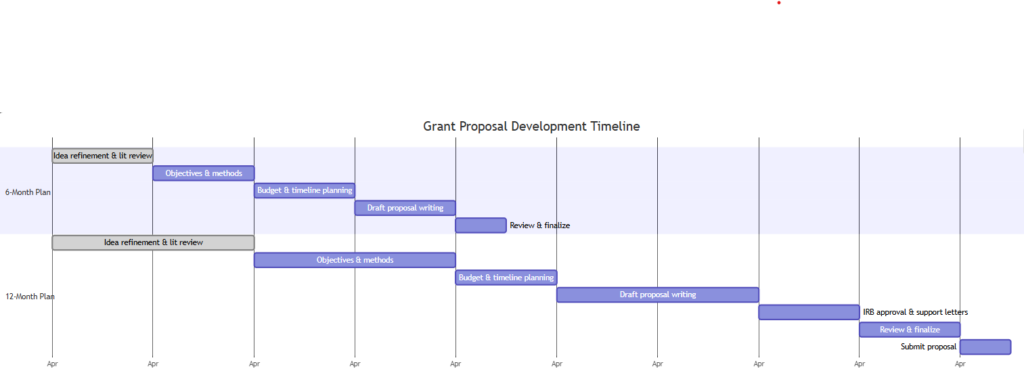
A successful grant proposal typically requires 6–12 months of planning, following structured phases from initial concept to final submission. In the early phase (roughly 3–6 months before the deadline), investigators refine the research question, conduct a literature/background review, and draft clear objectives or specific aims. During this stage the team is assembled and the project aligned with funder priorities, and a preliminary work plan or logic model (with an outline of activities and a rough budget) is developed. Deliverables include a focused concept note or one-page summary, draft aims/goals, and an outline of planned activities and costs – consistent with Babson’s advice to state project goals and target audiences explicitly in the work plan. At this point one also sketches a rough timeline and flags any needed ethics or regulatory approvals (e.g. IRB submission) so there is time to address them well before the full proposal deadline.
Mid-to-late stages (starting about 3 months out) involve drafting the full proposal narrative (background, methodology, evaluation plan, etc.) and finalizing the budget. Around 1–3 months before the deadline, the team creates a detailed project timeline, submits any required IRB or compliance applications, and gathers letters of support or collaboration commitments. Once a complete draft is ready (often 1–2 months out), it is circulated for internal and external review, revised for clarity and consistency with the funder’s guidelines, and polished along with the budget justification. The final deliverables include the complete proposal narrative, finalized budget and biosketches, all required attachments, and a submission package approved by institutional offices. Common pitfalls – such as underestimating the time needed for multiple revisions or missing key requirements (e.g. late IRB approval) – can be avoided by building in buffer time, conducting thorough internal reviews, and strictly following the funder’s instructions.
Below is an example schedule of primary tasks by month for both a 6-month and a 12-month proposal timeline:
6-Month Plan: Tasks & Deliverables
| Month 1–2 | Refine idea and goals; conduct literature/background reviewIdentify funding fit and collaboratorsDraft specific aims/objectives and outline approach |
| Month 3–4 | Develop detailed methodology and project designDraft key sections of proposal (need, objectives, methods)Begin budget estimates and IRB preparation if needed |
| Month 5–6 | Finalize full draft; revise based on team feedbackComplete budget, timeline/Gantt chart, and all attachmentsObtain final approvals and submit application |
12-Month Plan: Tasks & Deliverables
| Month 1–2 | Refine research concept; do broad literature reviewAssemble team/collaborators and define rolesDraft specific aims and high-level project plan |
| Month 4–6 | Develop methods and work plan in detailSecure preliminary data or pilot resultsBuild detailed budget and project timeline; start IRB application |
| Month 7–9 | Complete full proposal draft; gather letters of support/MOUsUpdate biosketches/CVs and other personnel infoInternal review and major revisions |
| Month 10–12 | Final editing, formatting and compliance checksInstitutional approvals (business office, grants office) and final sign-offsSubmit proposal (ideally a few days before deadline) |
Aligning with Funder Priorities
Grant proposals must speak directly to the funder’s mission and strategic goals, not just the applicant’s interests. Successful applications explicitly show that the project advances the funder’s agenda. To do this, first research the funder thoroughly: review its strategic plan, past funding announcements, and mission statements for key language and objectives. Contacting program officers or attending their webinars can clarify subtle priority shifts and funding emphases. Then tailor your proposal’s aims, outcomes, and impact statements to echo that language – essentially “connecting the dots” between what they want to achieve and what your project delivers. This approach demonstrates to reviewers that you’ve done your homework and are targeting your work to their goals.
Craft your specific aims and impact statements to mirror the funder’s priorities. For example, if the call emphasizes innovation or societal impact, highlight those aspects in your objectives and planned metrics. Demonstrate “fit” by citing your relevant track record and preliminary data that show you can do the work, and by describing partnerships or multidisciplinary strengths that add credibility. Use the exact RFP keywords in your narrative, and avoid vague or boilerplate language. A common mistake is submitting a generic proposal: instead, be explicit in using funder terms and evidence (statistics, quotes, or past successes) that prove your project directly supports the funder’s mission.
Budget Preparation and Justification
An accurate, well-justified budget is essential for any grant proposal – it shows reviewers you’ve planned the project’s costs realistically and responsibly. Key budget categories typically include personnel (salaries and fringe benefits), equipment, supplies/consumables, travel, consultant/subaward costs, and indirect (overhead) charges. Each cost should be based on current salary scales, vendor quotes, or historical expenses, with inflation or escalation applied as appropriate. Always calculate direct costs to meet sponsor formulas (e.g. full economic costing) and separately include your institution’s negotiated indirect rates. By submission, the deliverables are a detailed budget (by category and year) and a narrative budget justification linking each expense to the project aims.
Building the budget entails realistic cost estimation and clear justification. Use precise methods – vendor quotes, known salary rates and university tables – to estimate each item. The budget justification should concisely explain why each cost is needed (e.g. “2 graduate students at 50% effort for fieldwork”) and show it ties to specific tasks. All costs must meet sponsor rules: they should be allowable, necessary, and allocable to the project. For example, UKRI explicitly lists disallowed costs (e.g. alcohol, general contingencies, unrelated overheads) that must be omitted. Common pitfalls include arithmetic errors or forgetting items mentioned in the narrative, and failing to follow the funder’s format or caps. Deliverables at submission include the completed budget form/spreadsheet, the written justification, and any required institutional budget pages or approvals.
Stage & Key Tasks & Deliverables:
Planning:
- Identify budget categories and gather data (salary scales, quotes)
- Calculate effort and fringe for personnel, and estimate equipment, supplies, etc.
Drafting:
- Enter costs into budget form or spreadsheet by category
- Write the budget justification explaining each item in relation to project activities
Review :
- Check that all narrative elements are reflected in the budget and vice versa
- Verify arithmetic and compliance with funder guidelines (caps, eligibility)
Submission:
- Finalize and sign off on budget documents
- Submit all required budget forms and justification with the proposal
Writing compelling needs statements
Writing compelling needs statements is a foundational skill in grant writing, as it establishes the core rationale for why a project should exist in the first place. According to the Developing a Strong Need Statement, a needs statement defines the problem and provides the focus for the entire proposal, essentially driving every other section that follows. A truly effective statement goes beyond simply identifying a problem—it must present a clear, concise, and evidence-based explanation of why the issue matters and why immediate action is required. Without a compelling need, even the most innovative project can fail to gain support, as funders are primarily motivated by urgency, significance, and real-world impact.
To make a needs statement compelling, writers must balance data with narrative. This means combining credible statistics, research findings, and trends with a human-centered story that highlights who is affected and how. A strong statement clearly defines the problem, demonstrates its scale and urgency, and explains the consequences of inaction. It should focus on the needs of the community rather than the organization, ensuring that the argument remains relevant and impactful for stakeholders. Additionally, incorporating recent and localized data strengthens credibility and helps funders understand the depth and context of the issue being addressed.
Ultimately, a compelling needs statement is both logical and persuasive—it answers the critical question, “Why does this matter now?” By articulating the severity of the problem, identifying the affected population, and supporting claims with solid evidence, writers can create a narrative that resonates intellectually and emotionally. When done effectively, the needs statement not only justifies the project but also inspires confidence among funders, positioning the proposal as a necessary and timely solution to a pressing problem.
Real examples of successful vs. rejected proposals
Real-world examples of successful versus rejected proposals reveal a clear pattern: success is rarely accidental, and rejection is often tied to identifiable gaps. According to the Assessment criteria and rejection examples
, strong proposals tend to demonstrate a deep understanding of context, clear alignment with broader goals (such as development priorities), and a well-articulated pathway to impact. For instance, successful proposals explicitly connect their research to real-world challenges, show awareness of socio-economic and institutional conditions, and outline how outcomes will contribute to measurable change. In contrast, weaker submissions often fail to justify their relevance, overlook key contextual factors, or provide vague explanations of how their work will create meaningful impact, making it difficult for reviewers to see their value.
Another major distinction lies in clarity and originality. Successful proposals clearly define their research purpose, present innovative ideas, and link their work to existing knowledge gaps. On the other hand, rejected proposals frequently suffer from unclear objectives or lack of innovation—for example, appearing more like routine data collection or technical implementation rather than genuine research contributions. Review panels often highlight that proposals without clearly stated research questions, or those that fail to demonstrate how they generate new knowledge, struggle to compete. This reinforces the idea that originality must be both present and convincingly communicated, not merely implied.
Ultimately, the difference between acceptance and rejection often comes down to how well a proposal aligns, communicates, and justifies its purpose. Even a technically sound idea can be rejected if it lacks coherence, fails to follow guidelines, or does not align with the funder’s priorities. Successful proposals, by contrast, tell a cohesive story—one that integrates context, innovation, and impact into a compelling narrative. These examples highlight an important lesson for proposal writers: it is not enough to have a good idea; the strength of the proposal lies in how effectively that idea is framed, supported, and communicated to reviewers.