Author: Dr Mi Liu Ying
Introduction:
For decades, dietary advice has followed a “one-size-fits-all” approach: eat less fat, eat more fiber. But why do some people thrive on a low-carb diet while others gain weight? The answer is in the data. We are entering the age of Precision Nutrition, where generic recommendations are replaced by highly customized health plans driven by individual biometric data—your DNA, blood biomarkers, and real-time feedback from wearables. This shift is not just about better dieting; it’s about optimizing health down to the cellular level.
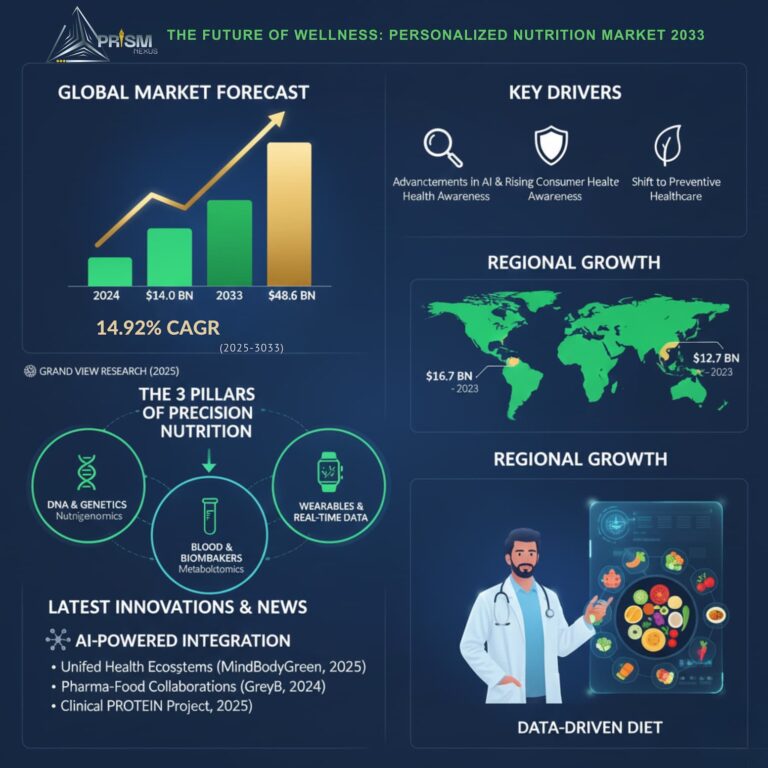
1. The Three Pillars of Precision Nutrition
Personalized nutrition (PN) leverages a multi-omics approach, integrating several distinct types of data to create a comprehensive biological profile.
A. DNA (Nutrigenetics & Nutrigenomics)
This analysis focuses on your relatively stable genetic blueprint.
- Nutrigenetics: How your genes influence your response to nutrients. For example, specific gene variants (like FTO or TCF7L2) can influence your risk of obesity and how efficiently you metabolize carbohydrates. Someone with a particular PPARG gene mutation, for instance, might derive greater cardiovascular benefit from a Mediterranean diet rich in monounsaturated fats (Ferguson et al., 2016).
- Nutrigenomics: How the food you eat “talks” to your genes, switching them on or off. This allows for dietary recommendations aimed at supporting healthy gene expression.
- Fact: Studies have shown that individuals carrying certain genetic risk alleles (e.g., FTO) lost 2.5 times more weight on a DNA-guided diet than on a standard, generic plan (Personalized DNA-Based Nutrition, 2025).
B. Bloodwork & The Microbiome
These provide a dynamic, current snapshot of your internal state—essential for understanding metabolism and nutrient status.
- Blood Biomarkers: Standard blood tests (e.g., Vitamin D, cholesterol, HbA1c) reveal current deficiencies, inflammation markers, and metabolic health. PN platforms use these to recommend specific micronutrient adjustments (e.g., personalized supplements) or targeted dietary changes.
- Microbiome Profiling: The gut microbiome, the collective of trillions of bacteria in your digestive tract, plays a critical role in nutrient absorption, inflammatory response, and the production of beneficial compounds like short-chain fatty acids (SCFAs).
- Scientific Reference: Research, including the PREDICT trials, has established that nutritional advice based on individual microbiota composition can better enhance postprandial (after-meal) glucose responses than generalized low-carbohydrate recommendations (Zeevi et al., 2015).
C. Wearables and Real-Time Feedback
This is the dynamic layer that tracks your body’s response in the moment.
- Continuous Glucose Monitors (CGMs): Originally for diabetes, CGMs are now a core tool in PN. They provide a precise, minute-by-minute understanding of how different foods, sleep, and stress impact your blood sugar.
- Fact: Wearable sensors and CGMs allow for dynamic dietary modifications by revealing the real-time metabolic impact of meals (Sempionatto et al., 2021). This data is often combined with activity tracking (steps, heart rate variability) to provide highly contextualized advice (e.g., “Since your sleep score was low, increase magnesium-rich foods today”).
Market Growth and Investment
The economic trajectory confirms that precision nutrition is moving from a niche service to a mainstream health category.
| Segment | Fact / Growth Rate | Implication for the Market |
| AI in Personalized Nutrition Platforms | Projected CAGR of 17.9% – 27.5% through 2034. | The technology connecting the data (DNA, wearables) is growing significantly faster than the overall market, making AI the core engine of personalization (Towards FnB, Global Market Insights). |
| Largest Revenue Segment | Vitamins accounted for the largest market share ($29.90%) of the overall revenue in 2024. | Personalized supplements (especially vitamins) are the most immediate and accessible entry point for consumers into PN (Grand View Research). |
| Fastest Growing Ingredient Segment | Probiotics are expected to grow fastest over the forecast period. | Driven by rising consumer awareness of gut health and its link to immunity and overall wellness (Grand View Research). |
| Dominant Distribution Channel | Online Pharmacies & E-commerce Sites accounted for the largest revenue share ($40.23%) in 2024. | PN is fundamentally a Direct-to-Consumer (DTC) market, heavily reliant on digital sales channels and subscription models (Grand View Research). |
| Geographic Leadership | North America holds the largest market share (approx. $40% in 2024), but Asia-Pacific is projected to be the fastest-growing region. | High consumer health spending and corporate presence in North America lead the way, while massive population and increasing health awareness in Asia-Pacific fuel future growth (Multiple sources). |
| Fastest Growing Product Type | Active Measurement solutions (using wearables, CGMs, etc.) are projected to be the fastest-growing segment. | This highlights the shift from one-time genetic testing to continuous, real-time metabolic and biometric monitoring (Mordor Intelligence, Markets and Markets). |
Fact: The global personalized nutrition market was estimated at USD 14.02 billion in 2024 and is projected to reach USD 48.57 billion by 2033, growing at a Compound Annual Growth Rate (CAGR) of nearly 15%. This rapid expansion is fueled by technological advancements (AI/Machine Learning) and increasing consumer demand for preventive healthcare (Grand View Research, 2025).
3. The Latest News: AI and Ecosystem Integration
The next frontier is the seamless integration of these data points using Artificial Intelligence.
- AI as the Connector: The latest developments focus on creating a unified health ecosystem. AI platforms are now capable of syncing genetic reports, daily sleep data from a smart ring, and real-time glucose readings from a CGM to create a truly 360-degree health trajectory (Mind Body Green, Dec 2025).
- Industry Players: Major food and tech players are accelerating development. For instance, Nestle has developed digital systems offering personalized nutritional guidance for intermittent fasting regimes, while companies like Healthycell and Panaceutics collaborate to create on-demand personalized nutrition gel formulas based on at-home blood test kits (GreyB, 2024).
- Clinical Trials: Large-scale research projects like the EU-Horizon 2020 PROTEIN project (NCT05951140) are actively investigating the use of mobile apps, continuous glucose monitoring, and activity trackers to improve metabolic outcomes in patients with Type 2 Diabetes and prediabetes, aiming to validate the real-world effectiveness of PN (ClinicalTrials.gov, 2025).
Conclusion: The Future of Food is Personal
The era of blanket dietary advice is over. Personalized Nutrition, powered by the fusion of DNA, bloodwork, and real-time wearable data, offers a scientifically grounded path to unprecedented health optimization. While challenges remain—specifically around data privacy and the need for continued scientific validation (nutritional science must catch up with the speed of data collection)—the direction is clear. By embracing these tools, we move closer to a world where our diet is not a guess, but a highly precise, data-driven prescription for optimal well-being.