
Ask most program staff in the development and NGO sector what “M&E” means to them, and you’ll often get a tired sigh before an answer. Too often, monitoring and evaluation is treated as a reporting obligation — a set of indicators bolted onto a project to satisfy a donor’s logframe template, filled in retroactively, and rarely looked at again until the next report is due.
That’s a missed opportunity, and an expensive one. Done well, monitoring and evaluation (M&E) isn’t paperwork — it’s the mechanism that tells an organization whether its work is actually achieving what it set out to achieve, and gives it the evidence to adjust course before resources are wasted on an approach that isn’t working.
This guide breaks down the core M&E frameworks used across the development sector, how they relate to each other, and how to build a system that generates real decision-making value — not just a report nobody reads. If you’ve read our earlier pieces on workforce resilience and SDG 8 or designing capacity-building programs, this is the natural next skill: knowing whether the capacity you built, or the resilience you strengthened, actually held up in practice.
Why M&E Is a Core Skill, Not a Compliance Task
For NGOs and development organizations, M&E sits at the intersection of accountability, learning, and funding. It matters for several interconnected reasons:
- Donor accountability. Nearly every major donor — from bilateral agencies to multilateral funds to private foundations — requires a defined M&E framework as a condition of funding, and increasingly expects evidence tied to internationally recognized evaluation standards.
- Adaptive management. A well-designed M&E system surfaces problems while a program is still running, not two years later in a final evaluation nobody can act on.
- Institutional learning. Organizations that treat M&E as a genuine feedback loop build a body of evidence about what works in their specific context — a serious competitive advantage when writing the next proposal.
- Staff and program credibility. In a sector where trust and evidence increasingly determine which organizations get funded, the ability to demonstrate results rigorously is now a professional skill in its own right, not a specialist’s side task.
Put simply: the organizations that treat M&E as core to program design, not an add-on at the end, are the ones that can prove — not just claim — their impact.
Monitoring vs. Evaluation: A Distinction Worth Getting Right
The two terms get used almost interchangeably, but they answer different questions.
Monitoring is the continuous, routine tracking of program activities, outputs, and progress against a plan — typically through regular data collection: attendance records, service delivery numbers, milestone tracking. It answers: Are we doing what we said we’d do, and are we on track?
Evaluation is the periodic, more rigorous assessment of a program’s design, implementation, and results — usually asking harder questions about whether the program caused the change it claims, and whether that change matters. It answers: Did it work, and was it worth doing?
A functioning M&E system needs both. Monitoring without evaluation tells you activities happened, but not whether they mattered. Evaluation without ongoing monitoring means flying blind until the final assessment — often too late to fix anything.
The Core Frameworks:
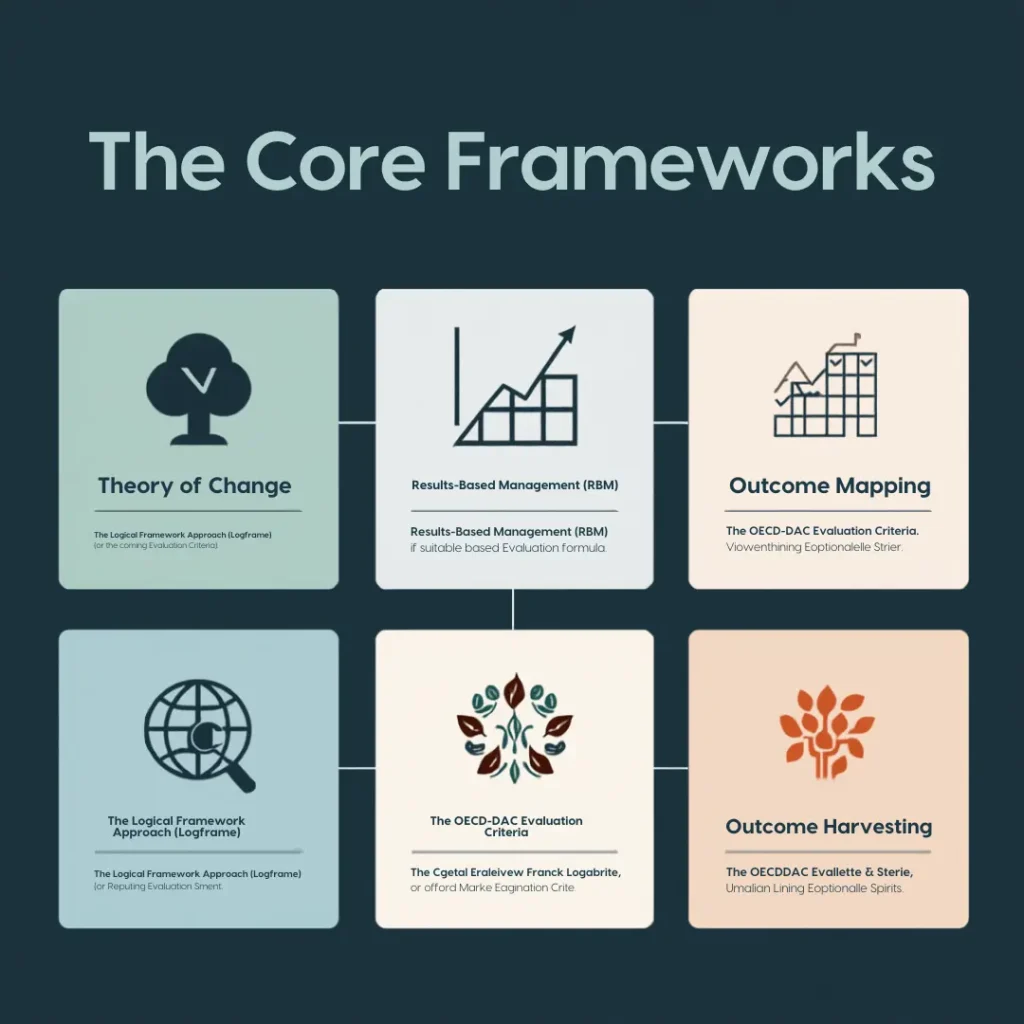
Theory of Change
A Theory of Change (ToC) is the foundational tool most other M&E frameworks build on. It maps out, explicitly, how and why a program is expected to lead to its intended long-term outcomes — laying out the causal pathway from activities, through outputs and intermediate outcomes, to final impact, along with the assumptions that need to hold true at each step.
A strong Theory of Change forces a program team to be honest about the logic connecting “we ran training sessions” to “workforce resilience improved” — and to identify, in advance, what else would need to be true for that link to hold (adequate follow-up support, employer buy-in, a stable labor market, and so on). This is where many well-intentioned programs quietly fall apart: the activities happen, but the underlying assumptions were never valid.
The Logical Framework Approach (Logframe)
The Logical Framework Approach, or logframe, translates a Theory of Change into a structured matrix — typically organized around a hierarchy of goal, purpose (or outcome), outputs, and activities, each paired with indicators, means of verification, and assumptions.
Logframes remain the most widely used planning and reporting tool in the sector, largely because most major donors require one. Their strength is clarity and comparability; their common weakness is rigidity — a logframe designed at proposal stage can become a straitjacket if the program team isn’t given room to revise it as context and understanding evolve.
Results-Based Management (RBM)
Results-Based Management is a broader management philosophy that logframes and ToCs often sit inside. RBM shifts the organizational focus from “did we spend the budget and complete the activities” to “did we achieve the intended results” — building results tracking into planning, budgeting, implementation, and reporting cycles simultaneously, rather than treating M&E as a separate, downstream function.
The OECD-DAC Evaluation Criteria
For evaluation specifically — as opposed to ongoing monitoring — the OECD Development Assistance Committee (DAC) evaluation criteria are the closest thing the sector has to a shared international standard. Originally set out in 1991 and revised in 2019, the framework now comprises six criteria used to judge the merit and worth of a development intervention:
- Relevance — Is the program addressing the right problem, for the right population, in the right context?
- Coherence — Does it fit with, reinforce, or conflict with other interventions operating in the same space? (Added in the 2019 revision.)
- Effectiveness — Did the program achieve its stated objectives?
- Efficiency — Are resources being converted into results in a reasonable, cost-effective way?
- Impact — What broader, longer-term difference did the program make — intended or not?
- Sustainability — Will the benefits continue after external funding or support ends?
These criteria aren’t a rigid checklist to score equally every time — they’re best treated as a menu. A well-scoped evaluation prioritizes the two or three criteria most relevant to the questions the organization actually needs answered, and builds sharp, specific evaluation questions around them, rather than spreading a limited budget thin across all six. Most major donors — including USAID, the Global Fund, and various UN agencies — expect evaluation terms of reference to map explicitly to the DAC criteria, making familiarity with the framework close to a baseline requirement for anyone drafting one.
Outcome Mapping and Outcome Harvesting
Where logframes work best for programs with fairly linear, predictable causal chains, Outcome Mapping and Outcome Harvesting were developed for messier, more complex change processes — capacity-building, advocacy, policy influence, and systems-level work, where predicting a precise chain of cause and effect in advance is unrealistic.
Outcome Mapping focuses on changes in the behavior, relationships, and practices of the people and institutions a program directly works with, rather than only on the program’s own outputs. Outcome Harvesting goes further, working backward: collecting evidence of outcomes that have actually occurred, then working with stakeholders to determine which of the program’s contributions plausibly helped cause them — useful when the change pathway genuinely couldn’t have been mapped accurately in advance.
Building an M&E Framework: A Practical Process
Step 1: Start with the Theory of Change, not the indicators
The most common mistake in M&E design is jumping straight to indicators — “what will we measure?” — before the causal logic is clear. Build the Theory of Change first, with the program team and, ideally, representatives of the people the program is meant to serve. Every indicator that follows should trace back to a specific link in that chain.
Step 2: Choose indicators that are genuinely useful, not just measurable
A common trap is selecting indicators because they’re easy to collect, not because they answer a meaningful question. Good indicators are:
- Specific to the outcome they’re meant to track
- Realistic to collect with the resources actually available
- Sensitive enough to detect real change within the program timeframe
- Balanced between quantitative and qualitative — numbers show scale, but rarely explain why something happened
Wherever possible, pair standard output indicators (people trained, sessions delivered) with at least one indicator further up the causal chain (behavior change, institutional practice, policy adoption) — otherwise the M&E system only ever proves activity happened, never that it mattered.
Step 3: Decide the monitoring cadence and ownership early
Define who collects what, how often, and how it flows into decision-making — not just into a donor report. A dashboard nobody reviews between quarterly reports isn’t adaptive management; it’s data collection for its own sake. Build in a regular internal review moment — monthly or quarterly — where program staff actually look at the monitoring data and ask what it means for the next phase of implementation.
Step 4: Plan the evaluation approach against the DAC criteria (or an equivalent standard)
Decide early which evaluation criteria matter most for this specific program and decide whether a mid-term, end-line, or both is warranted, and whether the causal structure is linear enough for a logframe-style evaluation or complex enough to warrant Outcome Harvesting instead.
Step 5: Build in a genuine feedback loop
The single biggest determinant of whether an M&E system is worth the investment is whether findings actually change anything. Build a specific mechanism — a structured review meeting, a defined threshold that triggers a course-correction conversation — that connects monitoring data and evaluation findings back to program decisions. Without this step, even the most rigorously designed framework becomes a compliance exercise.
Step 6: Resource M&E properly from the start
M&E frequently gets under-budgeted at the proposal stage, treated as an afterthought rather than a core program function. A realistic M&E system needs dedicated staff time, a modest but real data collection budget, and — for anything beyond routine monitoring — either in-house evaluation expertise or budget for an external evaluator.
Common Pitfalls in Development M&E
- Designing the logframe after the program, not before. Retrofitting indicators to match what already happened defeats the purpose of measuring anything.
- Treating M&E as the M&E officer’s job alone. Program staff need to own their own data, not hand it off to a specialist who wasn’t in the room for implementation decisions.
- Over-indexing on outputs. Counting people trained is easy; demonstrating that training changed behavior or improved outcomes is what funders and communities actually care about.
- Ignoring unintended outcomes. A rigid logframe can blind a team to real effects — positive or negative — that fall outside the original causal chain. Outcome Harvesting exists precisely to catch what a logframe misses.
- Collecting data nobody reviews. If monitoring data doesn’t feed a scheduled decision-making moment, it’s not really monitoring — it’s archiving.
- Skipping the assumptions column. The assumptions in a Theory of Change or logframe are often the first thing to break in the real world; revisiting them periodically is not optional.
Final Thoughts
A monitoring and evaluation framework is only as useful as the decisions it actually informs. The technical scaffolding — Theory of Change, logframe, DAC criteria, Outcome Harvesting — matters less than whether an organization has built the habit of asking hard questions about its own results and acting on the answers.
For NGO and development-sector teams already investing in workforce resilience and capacity-building work, M&E isn’t a separate skill bolted onto program design — it’s the discipline that proves whether that investment actually held up once the program ended and the real world took over.