
Research is the backbone of academic study, scientific discovery, and evidence-based decision-making. However, for many beginners, the idea of research methods can feel confusing and intimidating. With so many terms, approaches, and techniques, new researchers often struggle to know where to start.
This introduction to research methods is a practical, beginner-friendly guide designed to help new researchers understand the basics, explore different types of research methods, and learn how to apply them step by step. Whether you are a student, research assistant, or early-career academic, this guide will give you a clear foundation.
For academic resources and peer-reviewed papers, you can explore Google Scholar, which aggregates scholarly articles and theses from universities and research organizations worldwide.
What Are Research Methods?
Research methods are the systematic techniques used to plan, conduct, and analyze research. They define how data is collected, measured, and interpreted to answer a specific research question.
According to the George Mason University Libraries, research methods involve a set of procedures for collecting and analyzing data during research and help decide when and how to apply different approaches.
In simple terms:
- Research topic = what you want to study
- Research methods = how you study it
Choosing the right research method ensures that your findings are accurate, reliable, and meaningful.
Why Research Methods Matter
Understanding research methodology basics is essential for several reasons:
- They help you answer research questions effectively
- They improve the validity and reliability of your results
- They ensure ethical and transparent research practices
- They allow other researchers to replicate your study
- They strengthen the credibility of your work
For new researchers, strong research methods provide a clear roadmap and prevent common mistakes such as collecting irrelevant data or drawing unsupported conclusions.
For more in-depth examples of research methods across disciplines, you can refer to the Harvard University Methodology Sources Library Guide which explains how researchers operationalize hypotheses and choose appropriate methods
Types of Research Methods
There are three main types of research methods commonly used across disciplines. Understanding these is crucial for beginners.
Qualitative Research Methods
Qualitative research focuses on understanding experiences, meanings, opinions, and behaviors rather than numerical data.
Common qualitative research methods:
- In-depth interviews
- Focus group discussions
- Observations
- Case studies
- Open-ended questionnaires
Example:
A researcher interviews university students to explore their experiences with online learning.
Key characteristics:
- Non-numerical data (words, images, narratives)
- Small sample sizes
- Flexible and exploratory
- Provides deep insights
👉 Qualitative research is ideal when you want to understand why or how something happens.
Quantitative Research Methods
Quantitative research focuses on numerical data and statistical analysis. It aims to measure variables and identify patterns or relationships.
Common quantitative research methods:
- Surveys with closed-ended questions
- Experiments
- Structured questionnaires
- Statistical data analysis
Example:
A survey of 1,000 students measuring satisfaction with online classes using rating scales.
Key characteristics:
- Numerical data
- Large sample sizes
- Structured and objective
- Results can be generalized
👉 Quantitative research is best when you want to test hypotheses or measure outcomes.
Mixed Methods Research
Mixed methods research combines qualitative and quantitative approaches in a single study.
Example:
A researcher conducts a survey to collect numerical data and follows up with interviews to understand the reasons behind the results.
Why use mixed methods?
- Provides deeper understanding
- Balances numbers with human perspectives
- Strengthens research conclusions
👉 Mixed methods are useful for complex research problems that cannot be fully explained by one approach alone.
Research Methods vs Research Methodology
New researchers often confuse these two terms.
- Research methods refer to the specific tools and techniques used (surveys, interviews, experiments).
- Research methodology refers to the overall strategy and theoretical framework that guides the research.
In short:
- Methods = tools
- Methodology = strategy behind the tools
Understanding this distinction improves clarity when writing research proposals and theses.
Key Steps in the Research Process
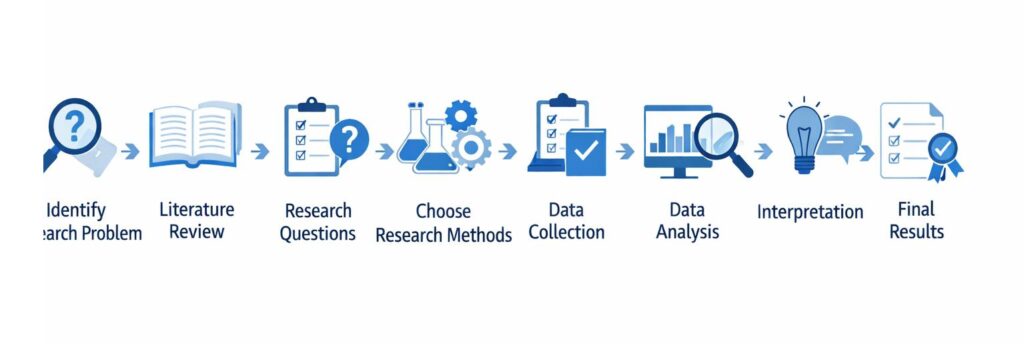
Following a structured research process helps beginners stay organized and focused.
Step 1: Identify the Research Problem
- Clearly define what you want to study and why it matters.
Step 2: Review the Literature
- Examine existing studies to understand what has already been researched and identify gaps.
Step 3: Formulate Research Questions or Hypotheses
- Develop clear, focused questions that guide your study.
Step 4: Choose Appropriate Research Methods
- Select qualitative, quantitative, or mixed methods based on your research goals.
Step 5: Collect Data
- Use suitable tools such as surveys, interviews, or experiments.
Step 6: Analyze Data
- Apply thematic analysis for qualitative data or statistical analysis for quantitative data.
Step 7: Interpret Findings
- Explain what your results mean in relation to your research questions.
Step 8: Write and Present Results
- Present findings clearly through reports, dissertations, or publications.
Examples of Research Methods for Beginners
Here are practical examples of commonly used research methods:
- Survey research: Collecting data through online questionnaires
- Experimental research: Testing cause-and-effect relationships in controlled environments
- Case study research: In-depth analysis of a specific organization or individual
- Observational research: Studying behavior without direct interaction
These methods are widely used in education, social sciences, business, and health research.
Ethical Considerations in Research
Ethics are a critical part of research methodology basics.
New researchers must ensure:
- Informed consent from participants
- Confidentiality and privacy
- No harm to participants
- Honest data reporting
Ignoring ethical standards can invalidate research and damage credibility.
Common Mistakes New Researchers Make
Many beginners struggle due to avoidable errors, such as:
- Selecting the wrong research method
- Using small or biased samples
- Ignoring ethical approval
- Poor data analysis
- Overgeneralizing results
Being aware of these mistakes helps improve research quality.
Tips for New Researchers
- Start with simple research questions
- Choose methods that match your skills and resources
- Use clear and simple language
- Seek feedback from supervisors or peers
- Practice reading and analyzing research papers
Research skills improve with practice and patience.
Final Thoughts
By learning different types of research methods, following a structured research process, and avoiding common mistakes, beginners can confidently conduct meaningful research. For personalized guidance, explore our Research and Publication Support services designed specifically for students and early-career researchers.
Research is not just about collecting data—it is about asking the right questions and using the right methods to find reliable answers.