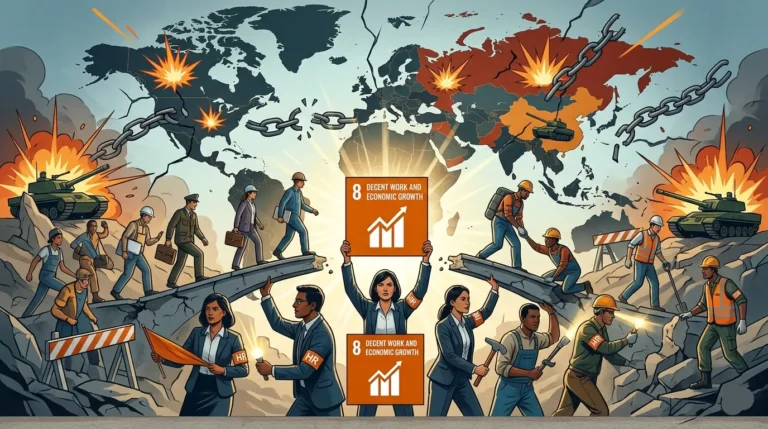
As wars rage across Ukraine, Sudan, Gaza, and beyond, the world’s workers bear a disproportionate cost. With progress on Decent Work and Economic Growth (SDG 8) stalling, this analysis examines what HR leaders, governments, and organisations must do differently — and urgently.
There is a specific kind of silence that falls over a destroyed factory floor. It is not the silence of a weekend or a public holiday. It is the silence of machines that will never restart, of workers who have fled, been conscripted, or simply disappeared into the fog of war. That silence, spreading across industrial zones in Kharkiv, tented camps outside Khartoum, and the rubble of Gaza City, is the sound of Sustainable Development Goal 8 being dismantled in real time.
We are living through the most protracted period of overlapping geopolitical crises since the Second World War. By early 2026, active armed conflicts span four continents. According to the Council on Foreign Relations’ annual Preventive Priorities Survey, published in December 2025, Gaza, Ukraine, Iran–Israel, and a potential cyberattack on U.S. infrastructure all rank as Tier I priority risks — the highest possible designation — for the first time simultaneously. The International Crisis Group’s January 2026 watch list catalogues ten conflicts at scale, noting that “the world was careening into a dangerous new era well before Donald Trump’s return to the White House. Things have mostly got worse.”
For organisations, business leaders, and HR practitioners, these conflicts do not remain at a comfortable distance. They arrive in the inbox as supply chain disruption notices, in the HR system as visa complications for relocated talent, in the employee assistance programme as elevated rates of anxiety and financial stress, and in the boardroom as geopolitical risk line items that no model was designed to contain.
The State of SDG 8: Stalled Progress in a World on Fire
Sustainable Development Goal 8 — “Promote sustained, inclusive and sustainable economic growth, full and productive employment and decent work for all” — was already under strain before the current wave of geopolitical instability took hold. But in 2026, it is not merely strained. It is, in several measurable dimensions, reversing.
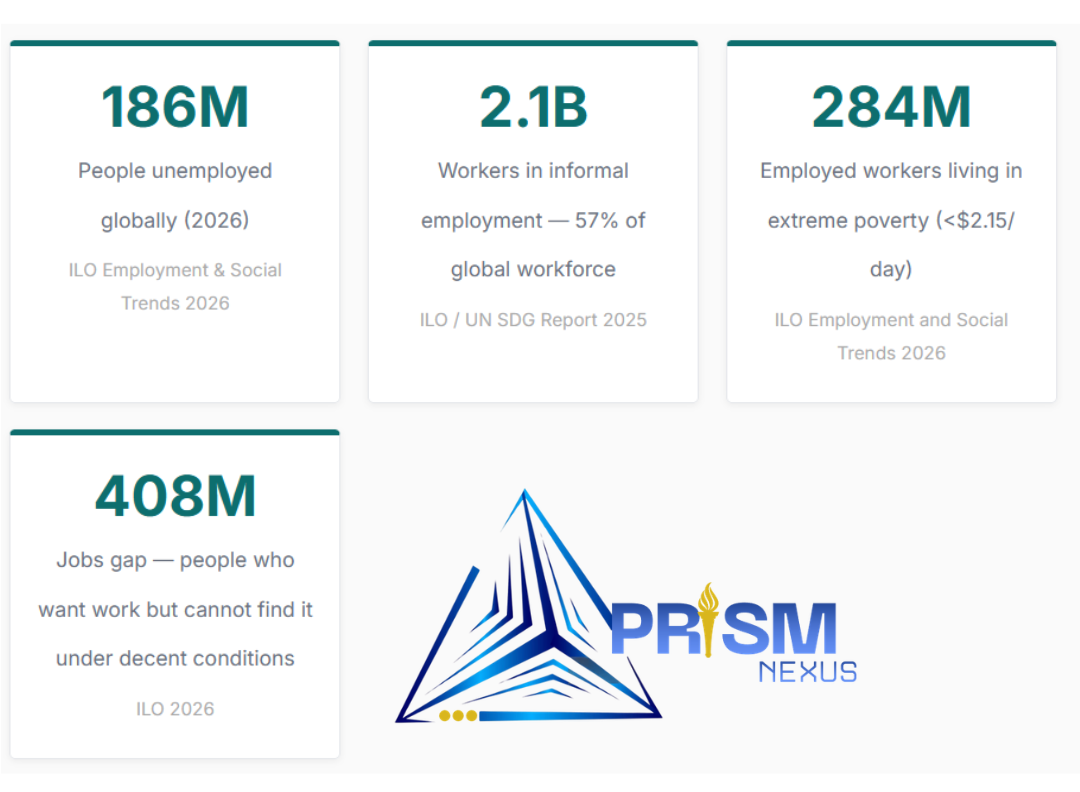
The ILO’s flagship Employment and Social Trends 2026 report, published on January 14, 2026, paints a landscape of stubborn paradox. Headline unemployment is stable at 4.9 percent — approximately 186 million people — and job growth has continued in low-income economies. Yet as ILO Director-General Gilbert Houngbo stated directly upon the report’s release: progress toward SDG 8 has ground to a halt.
“Unless governments, employers, and workers act together to harness technology responsibly and expand quality job opportunities for women and youth — through coherent and coordinated institutional responses — decent work deficits will persist and social cohesion will be at risk.”
— Gilbert Houngbo, Director-General, International Labour Organisation, January 2026
The data underneath the headline employment figures is considerably more alarming. Informal employment — which denies workers social protection, legal recourse, and basic job security — now engulfs 57 percent of the global workforce, a number barely budged since 2015. Youth unemployment stands at 11.9 percent, nearly three times the adult rate of 4.3 percent. The jobs gap — representing those who want work but cannot find it under decent conditions — has reached 408 million people. And compliance with fundamental labour rights, measured by SDG indicator 8.8.2 (freedom of association and collective bargaining), has deteriorated continuously since 2015, falling by 7 percent over that period.
Global GDP per capita growth, which underpins Target 8.1, is projected at just 1.5 percent for 2025 — well below the 7 percent annual growth target for least developed countries. The UN’s own SDG report notes that real GDP growth in LDCs “remains well below the 7 per cent target,” while productivity growth has only partially recovered from pandemic-era stagnation.
Trade is where geopolitics most visibly intersects with these numbers. In 2025, the global upheaval in international trade rules — driven primarily by U.S. tariff policy — directly impacted workers across Southeast Asia, Southern Asia, and Europe. The ILO estimates that trade supports approximately 465 million workers worldwide, with more than half concentrated in Asia and the Pacific. Tariff uncertainty has already suppressed wages in the most exposed regions.
Geopolitical Conflict as a Direct Workforce Disruptor
The relationship between armed conflict and workforce destruction is direct, measurable, and chronically under-reported in the business and HR literature. Conflict does not merely create instability in distant markets. It systematically dismantles the conditions that SDG 8 requires to function: safety, rule of law, freedom of association, access to education and training, and the physical infrastructure of work.
Ukraine: The Labour Market Cost of Invasion
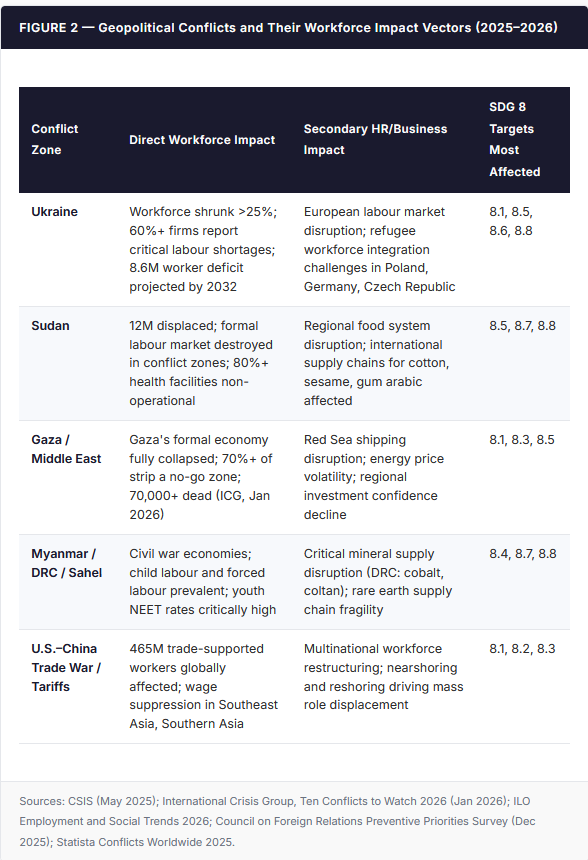
Russia’s full-scale invasion of Ukraine in February 2022 has produced a workforce catastrophe of a scale not seen in Europe since the Second World War. The country has lost 12 percent of its territory, more than a fifth of its economy, and an estimated two-thirds of its electrical infrastructure. According to CSIS analysis published in May 2025, Ukraine’s workforce shrank by more than 25 percent between 2021 and 2023 as workers emigrated, were conscripted, or became casualties. Labour shortages are now the private sector’s top concern: a 2024 survey by Ukraine’s Institute for Economic Research and Policy Consulting found that over 60 percent of companies reported difficulty hiring qualified workers.
The ILO estimates Ukraine will need an additional 8.6 million workers by 2032 simply to replace those lost since 2022. For the HR community, the implications extend far beyond Ukraine itself. Polish employers — who had relied heavily on Ukrainian labour in logistics, transport, and hospitality — have had to redesign workforce strategies around the loss of an entire labour cohort, while simultaneously managing the HR complexities of mass refugee integration.
“Geopolitical instability can have concrete, and highly disruptive, workforce implications. Forward-thinking employers can’t afford to be reactive. By investing early in resilience, flexibility, and integration, companies operating in volatile contexts will not just manage disruption — they will also strengthen their long-term competitive position.”
— Ius Laboris Global HR Law Network, August 2025
Sudan: The World’s Largest, Most Invisible Labour Crisis
While Ukraine commands global headlines, Sudan has quietly become what the International Crisis Group calls “the world’s most devastating” conflict in terms of the numbers of displaced and hungry people. By early 2026, more than 12 million Sudanese — over a third of the pre-war population — have fled their homes. More than 80 percent of health facilities in conflict zones are no longer operational. The conflict has effectively destroyed the country’s formal labour market in affected regions, pushing survivors into extreme informality, forced labour conditions, or complete economic exclusion.
Sudan’s crisis is a direct SDG 8 catastrophe. The ILO’s custodianship of SDG 8.7 — eliminating forced labour, modern slavery, and the worst forms of child labour — means nothing when armed groups systematically destroy the infrastructure, legal systems, and safety conditions that enforcement requires.
Gaza and the Middle East: Sector-Level Economic Destruction
The war in Gaza, which entered its third year in 2025 after Israel’s renewed offensive in March, has killed at least 70,000 people by the International Crisis Group’s January 2026 count, with more than 70 percent of the strip declared a no-go zone. Economically, Gaza’s formal labour market has collapsed entirely. The Houthi campaign in Yemen, which severely disrupted Red Sea commercial shipping throughout 2024–2025, disrupted trade routes that carry roughly 12 percent of global goods trade, creating inflationary pressures and supply chain instability that rippled through the labour costs of organisations across Europe, South Asia, and East Africa.
FIGURE 2 — Geopolitical Conflicts and Their Workforce Impact Vectors (2025–2026)
The Compounding Effect: When Geopolitics Meets AI and Demographic Disruption
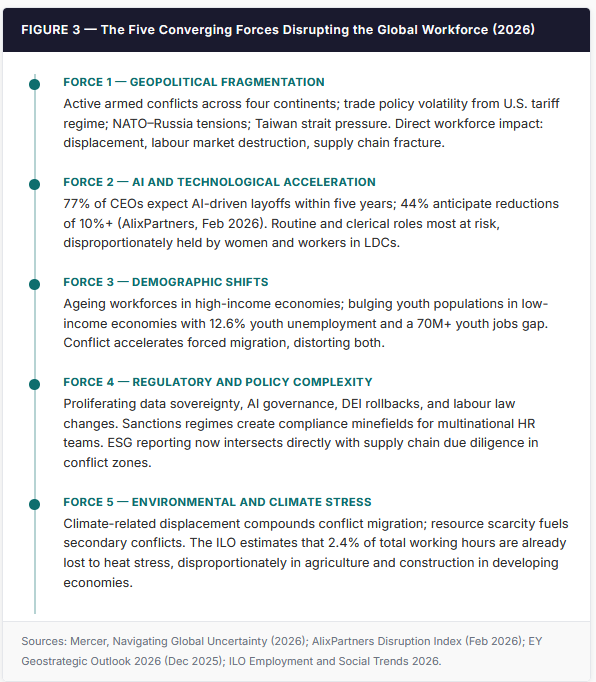
Geopolitical volatility does not operate in isolation. The AlixPartners 2026 Disruption Index, released in February 2026, found that 70 percent of CEOs report high disruption levels attributable simultaneously to AI adoption, geopolitical instability, supply chain shifts, and accelerating business model change. These forces are not additive — they are compounding, reinforcing, and accelerating one another.
The Deloitte 2026 Global Human Capital Trends report — drawn from a survey of over 9,000 business and HR leaders across 89 countries, published March 4, 2026 — describes organisations as experiencing “sustained strain, rising trust concerns, and cultural friction at the exact moment they need speed, resilience and reinvention.” One-third of surveyed workers experienced 15 major organisational changes in the past year alone. Yet only 27 percent of respondents believe their organisations manage change effectively, and a mere 7 percent say they are leading in helping their workforce continuously grow and adapt.
“HR must now manage a multidimensional risk landscape that includes AI ethics, workforce polarization, geopolitical instability, and regulatory shifts. Culture, and particularly psychological safety, will become a strategic stabilizer in this environment.”
— Joelle Wilson, Heidrick & Struggles, December 2025
The AI dimension is particularly consequential for SDG 8. The ILO warns that up to 40 percent of jobs could be affected by AI and automation by 2030, with routine tasks in manufacturing and administration most at risk. Simultaneously — and this is the uncomfortable paradox — conflict zones are precisely the environments where digital reskilling infrastructure is least available. The communities most at risk of AI-driven displacement are often the same communities whose educational and vocational infrastructure has been destroyed by conflict or neglected by chronic underdevelopment.
What HR Resilience Actually Requires in 2026
The language of “HR resilience” has become reflexively fashionable in the post-pandemic management literature. But resilience that is only a talking point in leadership retreats, rather than an operational reality embedded in workforce architecture, offers false comfort. In the context of geopolitical conflict, the gap between resilience as rhetoric and resilience as practice is measurable in livelihoods lost and SDG 8 targets missed.
The Mercer Navigating Global Uncertainty: From Business Disruption to Workforce Resilience report identifies four pillars of genuine workforce resilience that organisations must build simultaneously. Critically, the report emphasises that these pillars are not sequential — they must be developed in parallel, because disruption does not wait for the slowest pillar to catch up.
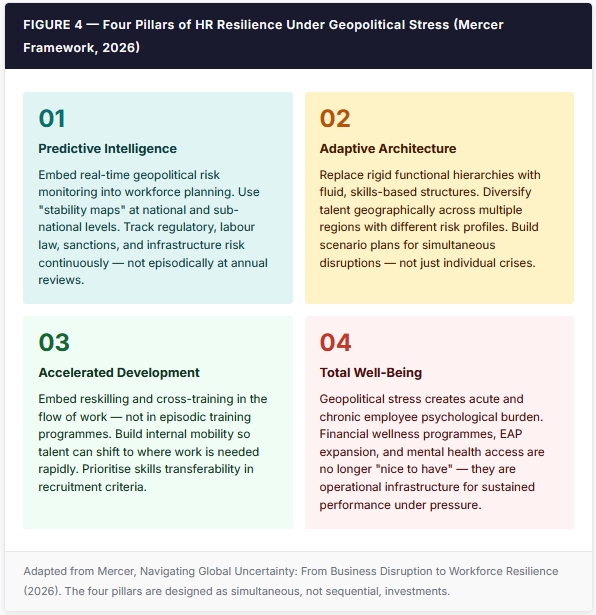
What makes 2026 different from previous cycles of disruption is the simultaneity of the pressures. The Deloitte analysis is blunt: “What makes this moment different is that the pressures on organizations are no longer sequential, but compounding. Technological advancement is converging with economic volatility, geopolitical tensions, societal expectations, and a rapidly shifting workforce.” The boundary between planning and execution has, in practice, collapsed.
“Organizations are facing a new reality. Change is relentless and the old playbook can’t keep up. HR’s future hinges on helping the organization operate differently. As work becomes more dynamic and skills-based, HR has a chance to lead a shift away from rigid functional silos toward a model where expertise moves to the work, work is designed around outcomes and learning is continuous, not episodic.”
— Kyle Forrest, U.S. Future of HR Leader, Deloitte; Simona Spelman, U.S. Human Capital Leader, Deloitte (2026 Global Human Capital Trends, March 2026)
The Duty of Care Problem in Conflict Zones
For organisations that operate in or near active conflict zones — and with ten simultaneous conflicts at scale in 2026, this encompasses more organisations than most HR functions have historically planned for — duty of care obligations have become strategically acute. The Business Continuity Institute’s March 2026 guidance on geopolitical disruption is explicit: “organisations that prioritise employee safety and wellbeing demonstrate stronger resilience during crises.” Yet the practical infrastructure to deliver on this — crisis management roles, escalation processes, cross-functional briefings involving risk, security, HR, and operations — is absent in most mid-sized organisations.
The Lewis Silkin Future @ Work 2026 analysis puts the governance challenge starkly: “Decisions about employee mobility, international assignments, remote-work policies and contractor engagement are increasingly shaped by geopolitical volatility rather than purely commercial logic. Employers must also contend with heightened duty-of-care obligations, balancing employee safety and wellbeing against legal, operational and reputational constraints that may shift rapidly as events unfold.”
The Gender Dimension: Conflict’s Unequal Workforce Burden
No analysis of SDG 8 and geopolitical conflict is complete without confronting the gendered dimension of workforce disruption. The ILO’s 2026 data shows a persistent 25-percentage-point employment gap between men and women globally. In Gulf Cooperation Council economies, women’s labour market participation stands at 39.5 percent against men’s 86.7 percent. In non-GCC Arab states, the gap widens to men at 66.1 percent and women at just 10.8 percent.
Armed conflict intensifies each of these disparities. UNFPA reported in 2025 that more than 900 health workers were killed in conflict zones in 2024 — the majority women providing frontline care — and 2025 is outpacing these numbers. The UN reported over 300 attacks on Ukrainian healthcare facilities since January 2025 alone. Women disproportionately bear the caregiving burden generated by conflict-related injury and displacement, further depressing their labour market participation precisely when reconstruction and recovery need their skills most.
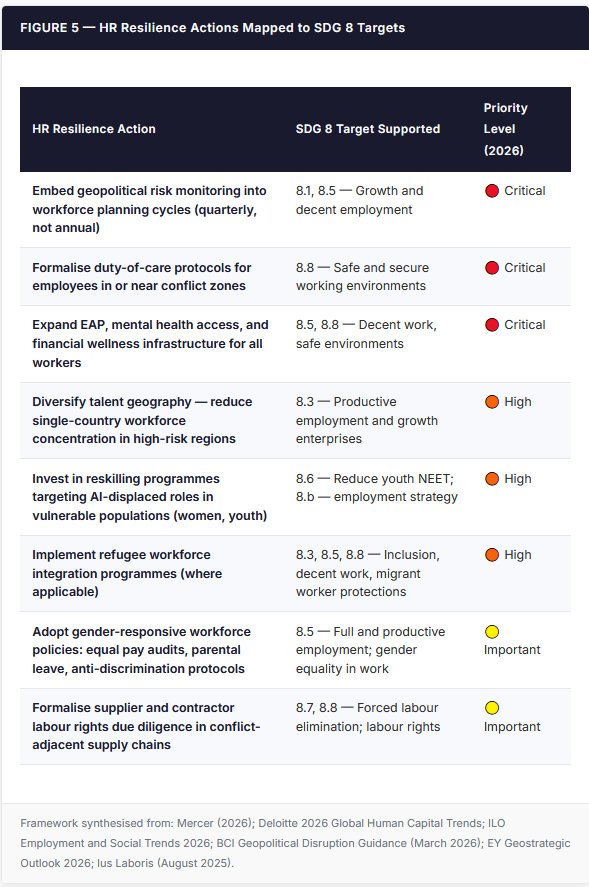
The SDG 8–HR Resilience Interface: A Strategic Framework for Practitioners
The relationship between HR practice and SDG 8 progress is not aspirational — it is operational. Organisations that build genuine workforce resilience generate the stable employment, decent work conditions, and skills infrastructure that SDG 8 targets require. Those that retreat to cost-cutting reflexes — which Mercer’s report specifically warns against as “the pitfall of traditional HR responses” — accelerate SDG 8 deterioration by converting formal jobs into informal, precarious arrangements.
What Good Looks Like: The Canadian Response as a Case Model Following the imposition of U.S. tariffs on steel, aluminium, and other goods in 2025, the Canadian government introduced targeted support packages for affected industries and strengthened skills training programmes at both federal and provincial levels. Ontario introduced legislation allowing extended temporary layoffs with additional career transition support. This combination of policy flexibility and active labour market investment is precisely what Locke and Latham’s goal-setting theory — and the ILO’s SDG 8 playbook — prescribes: challenging but achievable targets, feedback mechanisms, and genuine commitment from leadership. The ILO recommends exactly this “high-road” approach: investing in decent jobs via universal social protection, active labour market policies, and just transitions.
What Failure Looks Like: The Amazon Fulfilment Model at Scale At the opposite end of the spectrum, organisations that respond to geopolitical uncertainty by intensifying behavioural control mechanisms — automated productivity surveillance, punitive performance management, algorithmic dismissal — erode the very psychological safety and discretionary effort that resilience requires. Research consistently shows that aversive control environments produce compliance without commitment. In volatile environments, compliance without commitment means an organisation that performs when conditions are stable and collapses when they are not.
The 2030 Countdown: What Is Still Possible
With four years remaining until the SDG deadline of 2030, the trajectory for SDG 8 is not merely off track — it is, on several indicators, moving backwards. The global compliance score for fundamental labour rights has declined 7 percent since 2015. Informal employment has barely budged as a proportion of the workforce despite a decade of effort. The jobs gap has widened, not narrowed. And the geopolitical environment in early 2026 offers no credible near-term pathway to the stability that sustained economic growth and decent work require.
This is not an argument for fatalism. It is an argument for urgency, candour, and a fundamental reframing of what HR resilience means in this moment. The ILO’s prescriptions are clear: boost social protection floors to cover informal workers; invest in active labour market policies including subsidised training for youth and reskilling for AI-impacted roles; promote gender-inclusive policies including paid care leave and anti-discrimination laws; and foster international cooperation on trade and migration to stabilise flows.
The Deloitte research suggests that organisations capable of this shift do exist — but they are a small minority. The 7 percent of organisations described as “leading” in workforce adaptability share a common characteristic: they have embedded adaptation into the flow of work rather than treating it as a programme. They have treated culture as infrastructure, not as a communications exercise. They have designed work for human–machine collaboration rather than human replacement. And they have understood that in a world where geopolitical volatility is the baseline condition, the capacity to respond thoughtfully is itself the competitive advantage.
“The lesson for employers is not simply to cope with volatility, but to integrate geopolitical awareness into enterprise strategy, workforce design and leadership practice. In a world where disruption feels increasingly plausible and certainty is in short supply, organisations succeed not by predicting the next shock, but by building the capacity to respond to it thoughtfully, consistently and with purpose.”
— Lewis Silkin Future @ Work, January 2026
The silence of a destroyed factory floor is not inevitable. It is the result of choices — by governments that prioritised arms spending over social protection, by organisations that cut workforce resilience budgets at the first sign of financial pressure, by HR functions that were excluded from geopolitical risk discussions because “that’s not an HR issue.” In 2026, with every major index of global conflict at multi-decade highs and every major SDG 8 indicator flashing amber or red, that exclusion is no longer defensible.
The workers of Ukraine, Sudan, Gaza, Myanmar, and a dozen other conflict zones did not lose their livelihoods because of market forces. They lost them because the world’s systems — political, institutional, and organisational — failed to build sufficient resilience before the storms arrived. The only question that matters now is whether those systems will begin building it before the next ones do.
Key Takeaways for HR Practitioners and Policymakers Global unemployment is stable at 4.9%, but this masks a 408 million jobs gap, 284 million workers in extreme poverty, and labour rights compliance declining since 2015. Active conflicts in Ukraine, Sudan, Gaza, and beyond have directly destroyed formal labour markets and created secondary workforce disruptions across global supply chains. Deloitte’s 2026 data shows only 7% of organisations are effectively leading workforce adaptation — at the exact moment the pace of change demands it most. HR resilience is not an HR function responsibility alone: it requires integration of geopolitical awareness into enterprise strategy, supply chain due diligence, leadership development, and governance design. SDG 8 cannot be achieved without deliberate HR investment in formalisation, reskilling, gender equity, and labour rights — even, and especially, in volatile contexts.
References and Sources
- International Labour Organisation. World Employment and Social Trends 2026. ILO Publications, Geneva, January 14, 2026. UN News coverage
- United Nations Statistics Division. SDG Progress Report: Goal 8 — Decent Work and Economic Growth. UN DESA, 2025. unstats.un.org
- Deloitte Insights. 2026 Global Human Capital Trends: From Tensions to Tipping Points — Choosing the Human Advantage. Deloitte, March 4, 2026. deloitte.com
- Mercer. Navigating Global Uncertainty: From Business Disruption to Workforce Resilience. Mercer LLC, 2026. mercer.com
- AlixPartners. 2026 Disruption Index. February 2026. Reported in: Right Management Great Lakes, February 25, 2026. rightgreatlakes.com
- EY-Parthenon Geostrategic Business Group. EY Geostrategic Outlook 2026: Top 10 Geopolitical Developments. EY, December 2025. ey.com
- Council on Foreign Relations. Conflicts to Watch in 2026: Preventive Priorities Survey. CFR, December 2025. cfr.org
- International Crisis Group. 10 Conflicts to Watch in 2026. Crisis Group, January 22, 2026. crisisgroup.org
- Center for Strategic and International Studies (CSIS). Ukraine’s Future Rests on Its People. May 2025. csis.org
- Ius Laboris Global HR Law Network. Geopolitical Disruption and the Future of Work: What Does This Mean for Employers? August 2025. iuslaboris.com
- Lewis Silkin LLP. When Geopolitics Becomes Unpredictable: What Growing Uncertainty Means for Workforce Strategy. Future @ Work 2026, January 22, 2026. lewissilkin.com
- Business Continuity Institute (BCI). Navigating Geopolitical Disruption: What Every Organisation Needs to Know. March 16, 2026. thebci.org
- UNFPA. Health and Aid Workers Targeted in Conflicts Around the World. UN News, August 2025. news.un.org
- Council on Foreign Relations. Across Battlefields, Aid Workers Are Targeted More Than Ever. August 2025. cfr.org
- Houngbo, G. (ILO Director-General). Statement on ILO Employment and Social Trends 2026. UN News, January 14, 2026.
- UNLEASH. Deloitte, Heidrick & Struggles and McLean Reflect on HR in 2025, Plus What Must Be Top of the To-Do List in 2026. December 19, 2025. unleash.ai
- ILOSTAT. Charting Progress on the Global Goals and Decent Work. ILO Department of Statistics, March 2026. ilostat.ilo.org
- Supply & Demand Chain Executive / Emapta. Geopolitics and Talent Management: Global Workforce Strategies Must Evolve Amid Disruption. October 21, 2025. sdcexec.com
This article is intended for educational and professional development purposes. All statistics and quotations are sourced from publicly available, peer-reviewed or institutionally published reports as cited above. Figures and diagrams represent synthesised data from multiple primary sources.